
research use only
SUN11602 FGFR activator
Cat.No.S8192
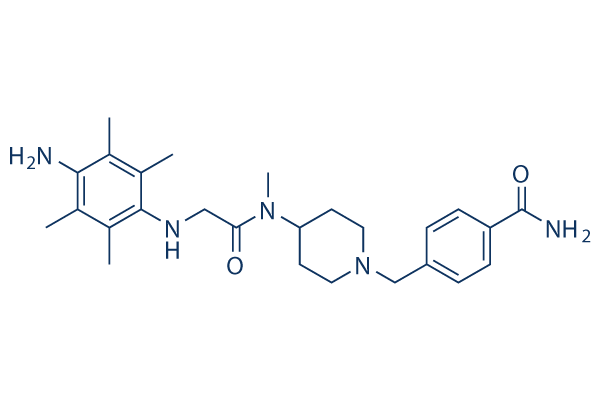
Chemical Structure
Molecular Weight: 451.60
Quality Control
| Related Targets | EGFR VEGFR JAK PDGFR Src HIF FLT FLT3 HER2 Bcr-Abl |
|---|---|
| Other FGFR Inhibitors | PD173074 AZD4547 (Fexagratinib) BLU9931 Futibatinib (TAS-120) LY2874455 PD-166866 Zoligratinib (Debio-1347) H3B-6527 Fisogatinib (BLU-554) SSR128129E |
Chemical Information, Storage & Stability
| Molecular Weight | 451.60 | Formula | C26H37N5O2 |
Storage (From the date of receipt) | |
|---|---|---|---|---|---|
| CAS No. | 704869-38-5 | Download SDF | Storage of Stock Solutions |
|
|
| Synonyms | N/A | Smiles | CC1=C(C(=C(C(=C1N)C)C)NCC(=O)N(C)C2CCN(CC2)CC3=CC=C(C=C3)C(=O)N)C | ||
Solubility
|
In vitro |
DMSO
: 90 mg/mL
(199.29 mM)
Ethanol : 31 mg/mL Water : Insoluble |
Molarity Calculator
|
In vivo |
|||||
In vivo Formulation Calculator (Clear solution)
Step 1: Enter information below (Recommended: An additional animal making an allowance for loss during the experiment)
Step 2: Enter the in vivo formulation (This is only the calculator, not formulation. Please contact us first if there is no in vivo formulation at the solubility Section.)
Calculation results:
Working concentration: mg/ml;
Method for preparing DMSO master liquid: mg drug pre-dissolved in μL DMSO ( Master liquid concentration mg/mL, Please contact us first if the concentration exceeds the DMSO solubility of the batch of drug. )
Method for preparing in vivo formulation: Take μL DMSO master liquid, next addμL PEG300, mix and clarify, next addμL Tween 80, mix and clarify, next add μL ddH2O, mix and clarify.
Method for preparing in vivo formulation: Take μL DMSO master liquid, next add μL Corn oil, mix and clarify.
Note: 1. Please make sure the liquid is clear before adding the next solvent.
2. Be sure to add the solvent(s) in order. You must ensure that the solution obtained, in the previous addition, is a clear solution before proceeding to add the next solvent. Physical methods such as vortex, ultrasound or hot water bath can be used to aid dissolving.
Mechanism of Action
| Targets/IC50/Ki |
bFGF
|
|---|---|
| In vitro |
Physiological actions of SUN11602 mimic several phenomena of the neuroprotection that is induced by bFGF. This compound plays a pivotal role in allowing primary cultured neurons to survive in adverse environments of glutamate toxicity and activating intracellular key molecules that are involved in the neuroprotective mechanisms. These actions are quite similar to those of bFGF. Such neuroprotective mechanisms are specific and distinctive to this compound and bFGF and differs clearly from those of the other growth factors that are investigated. But unlike bFGF, it can either directly or indirectly trigger the phosphorylation of the cytosolic domain of the FGFR without binding to the extracellular domain of the FGFR-1. This chemical demonstrates no cell proliferative activity of somatic cells, unlike bFGF. It significantly affects neuronal survival in adverse conditions through a FGFR1-mitogen-activated protein kinase/extracellular signal-regulated kinase-1/2 kinase (FGFR-1–MEK/ERK) signalling pathway.
|
| In vivo |
In WT mice, SUN11602 and bFGF increase the levels of newly synthesized Calb in cerebrocortical neurons and suppress the glutamate-induced rise in intracellular Ca2+. This Ca2+-capturing ability of Calb allows the neurons to survive severe toxic conditions of glutamate. In contrast, Calb levels remain unchanged in Calb-/- mice after exposure to this compound or bFGF, and due to a loss of function of the gene, these neurons are no longer resistant to toxic conditions of glutamate. Neuroprotective activities of this chemical and FGF-2 are due to exogenously induced hyperexpression of CalB in hippocampal neurons. The pharmacokinetic properties of this compound appear to hold promise in terms of bioavailability (>65%) after oral administration in rodents (rats and mice) and dogs (beagles).
|
References |
|
Tech Support
Tel: +1-832-582-8158 Ext:3
If you have any other enquiries, please leave a message.

Products are for research use only. Not for human use. We do not sell to patients.
©Copyright 2013 Selleck Chemicals. All Rights Reserved.