
research use only
BLU9931 FGFR inhibitor
Cat.No.S7819
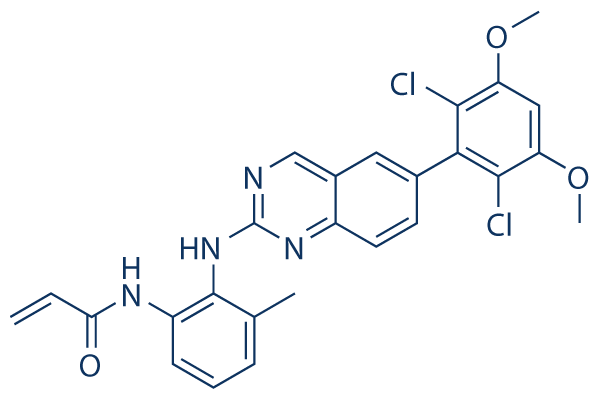
Chemical Structure
Molecular Weight: 509.38
Quality Control
| Related Targets | EGFR VEGFR JAK PDGFR Src HIF FLT FLT3 HER2 Bcr-Abl |
|---|---|
| Other FGFR Inhibitors | PD173074 AZD4547 (Fexagratinib) Futibatinib (TAS-120) LY2874455 PD-166866 Zoligratinib (Debio-1347) H3B-6527 Fisogatinib (BLU-554) SSR128129E Ferulic Acid |
Cell Culture, Treatment & Working Concentration
| Cell Lines | Assay Type | Concentration | Incubation Time | Formulation | Activity Description | PMID |
|---|---|---|---|---|---|---|
| MDA-MB-453 | Antiproliferative assay | 72 hrs | Antiproliferative activity against human MDA-MB-453 cells harboring FGFR4 Y367C mutant after 72 hrs by CCK8 assay, IC50=0.32μM. | 28523108 | ||
| MCF7 | Antiproliferative assay | 72 hrs | Antiproliferative activity against human MCF7 cells expressing low levels of FGFR4 after 72 hrs by CCK8 assay, IC50=2.34μM. | 28523108 | ||
| MDA-MB-231 | Antiproliferative assay | 72 hrs | Antiproliferative activity against human MDA-MB-231 cells expressing low levels of FGFR4 after 72 hrs by CCK8 assay, IC50=3.76μM. | 28523108 | ||
| sf9 | Function assay | 60 mins | Inhibition of non-phosphorylated N-terminal His6-tagged FGFR4 C477A mutant (G442 to E753 residues) (unknown origin) expressed in sf9 cells using 5-Fluo-Ahx-KKKKEEIYFFFG-NH2 as substrate after 60 mins by microfluidic mobility shift assay, IC50=0.0094μM. | ChEMBL | ||
| sf9 | Function assay | 60 mins | Inhibition of wild type non-phosphorylated N-terminal His6-tagged FGFR4 (G442 to E753 residues) (unknown origin) expressed in sf9 cells using 5-Fluo-Ahx-KKKKEEIYFFFG-NH2 as substrate after 60 mins by microfluidic mobility shift assay, IC50=0.011μM. | ChEMBL | ||
| Click to View More Cell Line Experimental Data | ||||||
Chemical Information, Storage & Stability
| Molecular Weight | 509.38 | Formula | C26H22Cl2N4O3 |
Storage (From the date of receipt) | |
|---|---|---|---|---|---|
| CAS No. | 1538604-68-0 | Download SDF | Storage of Stock Solutions |
|
|
| Synonyms | N/A | Smiles | CC1=C(C(=CC=C1)NC(=O)C=C)NC2=NC=C3C=C(C=CC3=N2)C4=C(C(=CC(=C4Cl)OC)OC)Cl | ||
Solubility
|
In vitro |
DMSO
: 100 mg/mL
(196.31 mM)
Water : Insoluble Ethanol : Insoluble |
Molarity Calculator
|
In vivo |
|||||
In vivo Formulation Calculator (Clear solution)
Step 1: Enter information below (Recommended: An additional animal making an allowance for loss during the experiment)
Step 2: Enter the in vivo formulation (This is only the calculator, not formulation. Please contact us first if there is no in vivo formulation at the solubility Section.)
Calculation results:
Working concentration: mg/ml;
Method for preparing DMSO master liquid: mg drug pre-dissolved in μL DMSO ( Master liquid concentration mg/mL, Please contact us first if the concentration exceeds the DMSO solubility of the batch of drug. )
Method for preparing in vivo formulation: Take μL DMSO master liquid, next addμL PEG300, mix and clarify, next addμL Tween 80, mix and clarify, next add μL ddH2O, mix and clarify.
Method for preparing in vivo formulation: Take μL DMSO master liquid, next add μL Corn oil, mix and clarify.
Note: 1. Please make sure the liquid is clear before adding the next solvent.
2. Be sure to add the solvent(s) in order. You must ensure that the solution obtained, in the previous addition, is a clear solution before proceeding to add the next solvent. Physical methods such as vortex, ultrasound or hot water bath can be used to aid dissolving.
Mechanism of Action
| Targets/IC50/Ki |
FGFR4
(Cell-free assay) 3 nM
FGFR3
(Cell-free assay) 150 nM
|
|---|---|
| In vitro |
In MDA-MB-453 cells, BLU9931 potently inhibits phosphorylation of FGFR4 signalling pathway. This compound inhibits proliferation of HCC cell lines that express an intact FGFR4 signalling complex, such as Hep 3B, HUH-7, and JHH-7 cell lines, with EC50 of <1 μM. It also inhibits proliferation in PDX-derived cell lines with an intact FGFR4 signalling pathway.
|
| Kinase Assay |
FGFR1-4 Biochemical Assays
|
|
FGFR kinase inhibition assays are performed at KM for ATP. Picomolar to low nanomolar concentrations of FGFR proteins are incubated in 1× Kinase Reaction Buffer (KRB) with 1 μM of CSKtide and 50 to 250 of μM ATP at 25°C for 90 minutes in the presence or absence of a dosed concentration series of this compound. All reactions are terminated by the addition of Stop buffer, and plates are read on a Caliper EZReader2. IC50 values are fit with a four-parameter log[Inhibitor] versus response model with floating Hill Slope.
|
|
| In vivo |
In mice bearing the FGF19-amplified Hep 3B liver tumours, BLU9931 (300 mg/kg, p.o.) leads to tumour regression and prevents this weight loss induced by tumours. In mice bearing the FGF19-overexpressing PDX-derived LIXC012 xenografts, treatment with this compound also leads to tumour regression.
|
References |
Tech Support
Tel: +1-832-582-8158 Ext:3
If you have any other enquiries, please leave a message.

Products are for research use only. Not for human use. We do not sell to patients.
©Copyright 2013 Selleck Chemicals. All Rights Reserved.