
research use only
Prochlorperazine dimaleate salt Dopamine Receptor antagonist
Cat.No.S4631
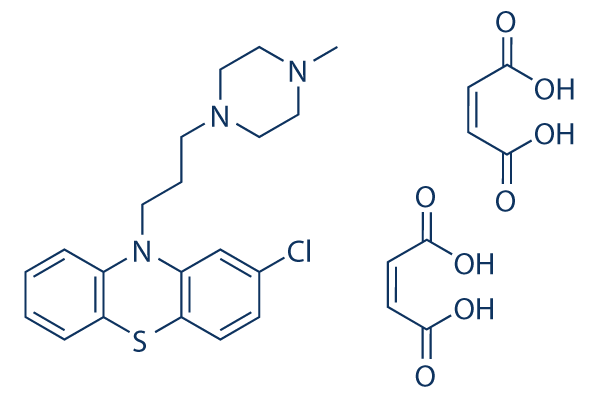
Chemical Structure
Molecular Weight: 606.09
Quality Control
| Related Targets | Adrenergic Receptor AChR 5-HT Receptor COX Calcium Channel Histamine Receptor GABA Receptor TRP Channel Cholinesterase (ChE) GluR |
|---|---|
| Other Dopamine Receptor Inhibitors | MPTP Hydrochloride Trifluoperazine Trifluoperazine 2HCl Penfluridol Sulpiride Levosulpiride SCH-23390 hydrochloride Domperidone Rotundine Azaperone |
Chemical Information, Storage & Stability
| Molecular Weight | 606.09 | Formula | C20H24ClN3S.C8H8O8 |
Storage (From the date of receipt) | |
|---|---|---|---|---|---|
| CAS No. | 84-02-6 | Download SDF | Storage of Stock Solutions |
|
|
Solubility
|
In vitro |
DMSO
: 27 mg/mL
(44.54 mM)
Water : Insoluble Ethanol : Insoluble |
Molarity Calculator
|
In vivo |
|||||
In vivo Formulation Calculator (Clear solution)
Step 1: Enter information below (Recommended: An additional animal making an allowance for loss during the experiment)
Step 2: Enter the in vivo formulation (This is only the calculator, not formulation. Please contact us first if there is no in vivo formulation at the solubility Section.)
Calculation results:
Working concentration: mg/ml;
Method for preparing DMSO master liquid: mg drug pre-dissolved in μL DMSO ( Master liquid concentration mg/mL, Please contact us first if the concentration exceeds the DMSO solubility of the batch of drug. )
Method for preparing in vivo formulation: Take μL DMSO master liquid, next addμL PEG300, mix and clarify, next addμL Tween 80, mix and clarify, next add μL ddH2O, mix and clarify.
Method for preparing in vivo formulation: Take μL DMSO master liquid, next add μL Corn oil, mix and clarify.
Note: 1. Please make sure the liquid is clear before adding the next solvent.
2. Be sure to add the solvent(s) in order. You must ensure that the solution obtained, in the previous addition, is a clear solution before proceeding to add the next solvent. Physical methods such as vortex, ultrasound or hot water bath can be used to aid dissolving.
Mechanism of Action
| Targets/IC50/Ki |
D2 receptor
|
|---|---|
| In vitro |
Prochlorperazine down-regulates cyclin E2 and reduces cell proliferation in MCF-7 cells that are resistant to tamoxifen. It has the potential to impact on estrogen receptor (ER) function and alter response to endocrine therapy.
|
| In vivo |
Prochlorperazine is showed to be able to induce antinociception in mice. prochlorperazine-treated mice show a complete integrity of motor co-ordination on the rota-rod test, normal spontaneous motility, as well as exploratory behaviour as revealed by the hole-board test. The antinociceptive effect of prochlorperazine appears to be due to the antagonism of D2 receptors since the increase of the pain threshold induced by the investigated compound is prevented by pretreatment with the D2 agonist quinpirole.
|
References |
|
Tech Support
Tel: +1-832-582-8158 Ext:3
If you have any other enquiries, please leave a message.

Products are for research use only. Not for human use. We do not sell to patients.
©Copyright 2013 Selleck Chemicals. All Rights Reserved.