
research use only
MPTP Hydrochloride Dopaminergic Neurotoxin
Cat.No.S4732
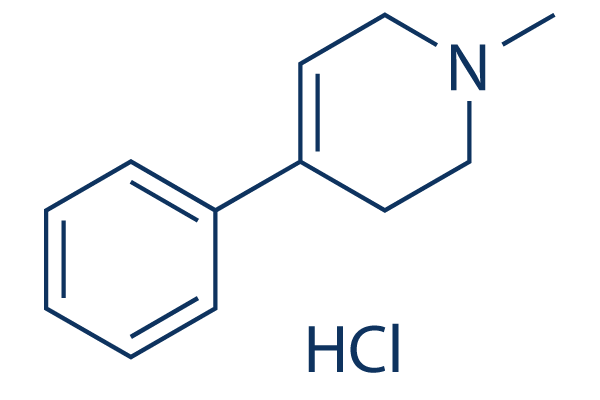
Chemical Structure
Molecular Weight: 209.72
Jump to
Quality Control
Batch:
Purity:
99.94%
99.94
| Related Targets | Adrenergic Receptor AChR 5-HT Receptor COX Calcium Channel Histamine Receptor GABA Receptor TRP Channel Cholinesterase (ChE) GluR |
|---|---|
| Other Dopamine Receptor Inhibitors | Trifluoperazine Trifluoperazine 2HCl Penfluridol Sulpiride Levosulpiride SCH-23390 hydrochloride Domperidone Rotundine Azaperone SKF38393 HCl |
Cell Culture, Treatment & Working Concentration
| Cell Lines | Assay Type | Concentration | Incubation Time | Formulation | Activity Description | PMID |
|---|---|---|---|---|---|---|
| insect cells | Function assay | 120 mins | Inhibition of human recombinant MAOA expressed in insect cells assessed as oxidation of kynuramine substrate at 50 uM measured after additional enzyme added after 120 mins incubation | 22078410 | ||
| insect cells | Function assay | 90 mins | Inhibition of human recombinant MAOA expressed in insect cells assessed as oxidation of kynuramine substrate at 50 uM measured after additional substrate added after 90 mins incubation | 22078410 | ||
| Click to View More Cell Line Experimental Data | ||||||
Chemical Information, Storage & Stability
| Molecular Weight | 209.72 | Formula | C12H15N·HCl |
Storage (From the date of receipt) | |
|---|---|---|---|---|---|
| CAS No. | 23007-85-4 | Download SDF | Storage of Stock Solutions |
|
|
| Synonyms | N/A | Smiles | CN1CCC(=CC1)C2=CC=CC=C2.Cl | ||
Solubility
|
In vitro |
Water : 41 mg/mL Ethanol : 41 mg/mL
DMSO
: 26 mg/mL
(123.97 mM)
|
Molarity Calculator
Dilution Calculator
Molecular Weight Calculator
|
In vivo |
|||||
In vivo Formulation Calculator (Clear solution)
Step 1: Enter information below (Recommended: An additional animal making an allowance for loss during the experiment)
mg/kg
g
μL
Step 2: Enter the in vivo formulation (This is only the calculator, not formulation. Please contact us first if there is no in vivo formulation at the solubility Section.)
% DMSO
%
% Tween 80
% ddH2O
%DMSO
%
Calculation results:
Working concentration: mg/ml;
Method for preparing DMSO master liquid: mg drug pre-dissolved in μL DMSO ( Master liquid concentration mg/mL, Please contact us first if the concentration exceeds the DMSO solubility of the batch of drug. )
Method for preparing in vivo formulation: Take μL DMSO master liquid, next addμL PEG300, mix and clarify, next addμL Tween 80, mix and clarify, next add μL ddH2O, mix and clarify.
Method for preparing in vivo formulation: Take μL DMSO master liquid, next add μL Corn oil, mix and clarify.
Note: 1. Please make sure the liquid is clear before adding the next solvent.
2. Be sure to add the solvent(s) in order. You must ensure that the solution obtained, in the previous addition, is a clear solution before proceeding to add the next solvent. Physical methods such as vortex, ultrasound or hot water bath can be used to aid dissolving.
Mechanism of Action
| In vitro |
The morphology of N2AB-1 and glioma cells was unaltered when these cells were exposed to all doses of MPTP Hydrochloride. And, C6 glioma cell proliferation was also unaffected by this compound treatment. MPTP Promotes Apoptosis and Tau Phosphorylation in Human Neuroblastoma M17 Cells. This compound significantly promotes Tau phosphorylation at Ser262 in human neuroblastoma M17 cells. It caused a dose-dependent increase in the intracellular α-synuclein level in our M17 human neuroblastoma cells. This chemical appears to promote Tau phosphorylation in the brain by activating both PKA and GSK3β.
|
|---|---|
| In vivo |
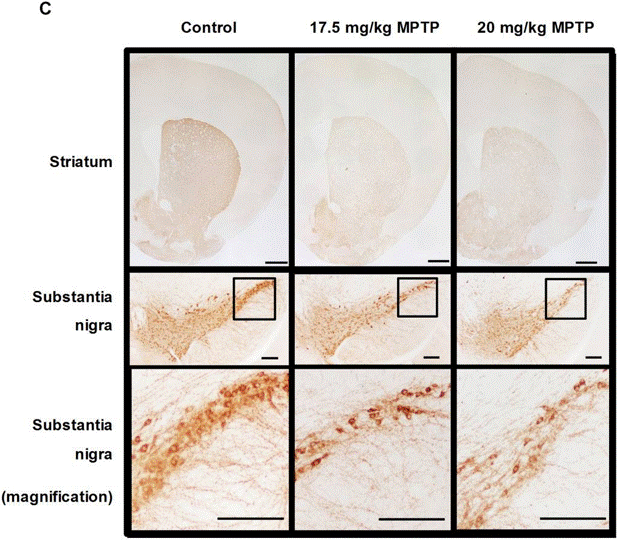
The number of tyrosine hydroxylase-positive neurons was decreased in the substantia nigra pars compacta of MPTP-treated mice. This compound decreased thioredoxin reductase 1 expression and thioredoxin reductase activity in the mouse midbrain, reduced the number of thioredoxin reductase 1-positive cells in the substantia nigra pars compacta of mice. Administration of this toxin can cause neurochemical, behavioral and histopathological alterations in human and nonhuman primates that are similar to those observed in Parkinsonian patients. Compared with primates, rodents are insensitive to MPTP. This chemical can be administered by various routes, such as gavage and stereotactic injection, but the most common and reproducible route is systemic administration, including subcutaneous, intravenous, intraperitoneal and intramuscular injection. It is a lipophilic protoxin that can rapidly cross the blood-brain barrier following systemic injection. Once it enters the brain, MPTP is converted to 1-methyl-4-phenylpyridine by monoamine oxidase B. It has been shown to be toxic to dopaminergic neurons of the nigrostriatal system in humans, monkeys, and mice and to produce long-lasting depletion of DA and its metabolites in the striatum.
|
References |
|
Applications
| Methods | Biomarkers | Images | PMID |
|---|---|---|---|
| Western blot | TH / Actin pCaMKIIβ / pCaMKIIα / CaMKIIβ / CaMKIIα / β-Actin TH / p-α-Syn / α-Syn / β-actin / CDK5 / LC3-I / LC3-II / p62 / NLRP3 / ASC / Casp1 p20 / Procasp1 p-ERK1/2 / ERK1/2 / GAPDH GDH2 / GDH1 / GFAP / GAPDH |

|
23391753 |
| IHC | tyrosine hydroxylase (TH) tyrosine hydroxylase (TH) SNpc tyrosine hydroxylase (TH) Substantia nigra |
|
31427934 |
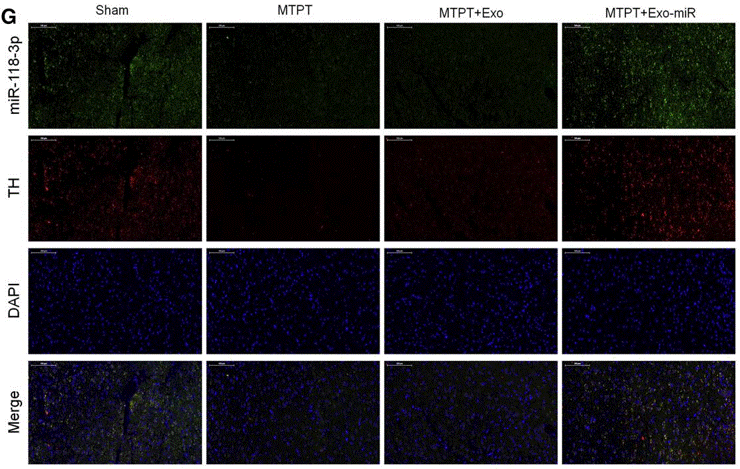
| Immunofluorescence | tyrosine hydroxylase (TH) / miR-188-3p α-Syn tyrosine hydroxylase (TH) / Tunel tyrosine hydroxylase (TH) / Tunel tyrosine hydroxylase (TH) GFAP |
|
33717653 |
Tech Support
Tel: +1-832-582-8158 Ext:3
If you have any other enquiries, please leave a message.

Products are for research use only. Not for human use. We do not sell to patients.
©Copyright 2013 Selleck Chemicals. All Rights Reserved.