
research use only
GSK583 RIP kinase inhibitor
Cat.No.S8261
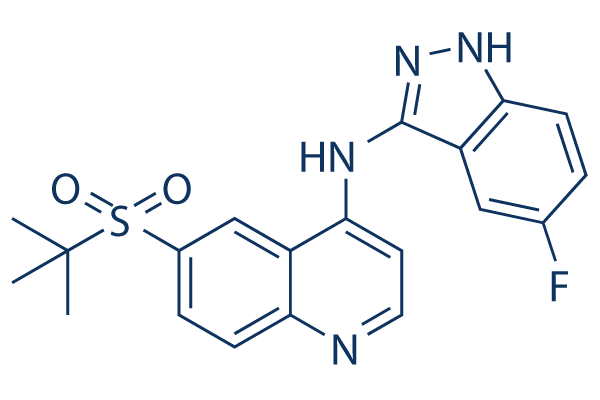
Chemical Structure
Molecular Weight: 398.45
Quality Control
| Related Targets | Bcl-2 Caspase PD-1/PD-L1 Ferroptosis p53 Apoptosis related Synthetic Lethality STAT TNF-alpha Ras |
|---|---|
| Other RIP kinase Inhibitors | Necrostatin-1 (Nec-1) Necrostatin 2 racemate (Nec-1s) GSK872 Mito-TEMPO GSK'963 RIPA-56 GSK2982772 Resibufogenin HS-1371 GSK2983559 (compound 3) |
Chemical Information, Storage & Stability
| Molecular Weight | 398.45 | Formula | C20H19FN4O2S |
Storage (From the date of receipt) | |
|---|---|---|---|---|---|
| CAS No. | 1346547-00-9 | Download SDF | Storage of Stock Solutions |
|
|
| Synonyms | N/A | Smiles | CC(C)(C)S(=O)(=O)C1=CC2=C(C=CN=C2C=C1)NC3=NNC4=C3C=C(C=C4)F | ||
Solubility
|
In vitro |
DMSO
: 79 mg/mL
(198.26 mM)
Ethanol : 28 mg/mL Water : Insoluble |
Molarity Calculator
|
In vivo |
|||||
In vivo Formulation Calculator (Clear solution)
Step 1: Enter information below (Recommended: An additional animal making an allowance for loss during the experiment)
Step 2: Enter the in vivo formulation (This is only the calculator, not formulation. Please contact us first if there is no in vivo formulation at the solubility Section.)
Calculation results:
Working concentration: mg/ml;
Method for preparing DMSO master liquid: mg drug pre-dissolved in μL DMSO ( Master liquid concentration mg/mL, Please contact us first if the concentration exceeds the DMSO solubility of the batch of drug. )
Method for preparing in vivo formulation: Take μL DMSO master liquid, next addμL PEG300, mix and clarify, next addμL Tween 80, mix and clarify, next add μL ddH2O, mix and clarify.
Method for preparing in vivo formulation: Take μL DMSO master liquid, next add μL Corn oil, mix and clarify.
Note: 1. Please make sure the liquid is clear before adding the next solvent.
2. Be sure to add the solvent(s) in order. You must ensure that the solution obtained, in the previous addition, is a clear solution before proceeding to add the next solvent. Physical methods such as vortex, ultrasound or hot water bath can be used to aid dissolving.
Mechanism of Action
| Targets/IC50/Ki |
RIP2
(Cell-free assay) 5 nM
RIP3
(Cell-free assay) 16 nM
|
|---|---|
| In vitro |
GSK583 possesses comparable binding affinity for RIP3 kinase as demonstrated by an in-house FP binding assay configured similarly to the RIP2 FP assay (RIP2 FP IC50 = 5 nM; RIP3 FP IC50 = 16 nM). Despite this potent biochemical activity against RIP3 kinase, this compound shows little or no inhibition of RIP3-dependent necroptotic cell death in a cellular assay up to 10 μM concentration. It potently and dose dependently inhibits MDP-stimulated tumor necrosis factor-alpha (TNFα) production with an IC50 = 8 nM in primary human monocytes. Following treatment with this chemical at 1 μM, little inhibition of pro-inflammatory signaling is observed upon activation of Toll-like receptors (TLR2, TLR4, TLR7) or cytokine receptors (IL-1R, TNFR) but complete inhibition is observed upon activation of both NOD1 and NOD2 receptors, which signal in a RIP2-dependent manner. Although it has excellent kinase selectivity, this compound does inhibit both the hERG channel and Cyp3A4, which precludes it from further progression as a drug candidate.
|
| In vivo |
GSK583 has low clearance, moderate volumes of distribution, and moderate oral bioavailability in both rat and mouse. Eventhough this compound would not produce a human phamacodynamic response within an acceptable dose range which precludes this molecule from further development as a drug candidate, the oral PK in rat and mouse provides sufficient systemic exposure for use as a preclinical in vivo tool molecule in an acute inflammation challenge model.
|
References |
Tech Support
Tel: +1-832-582-8158 Ext:3
If you have any other enquiries, please leave a message.

Products are for research use only. Not for human use. We do not sell to patients.
©Copyright 2013 Selleck Chemicals. All Rights Reserved.