
research use only
AMG-517 TRP Channel antagonist
Cat.No.S7115
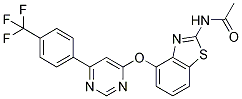
Chemical Structure
Molecular Weight: 430.4
Quality Control
| Related Targets | CFTR CRM1 CD markers AChR Calcium Channel Sodium Channel Potassium Channel GABA Receptor ATPase GluR |
|---|---|
| Other TRP Channel Inhibitors | 2-APB (2-Aminoethyl Diphenylborinate) SKF96365 GSK2193874 GSK1016790A HC-030031 Capsazepine EIPA (L593754) SB705498 HC-067047 ML-SI3 |
Chemical Information, Storage & Stability
| Molecular Weight | 430.4 | Formula | C20H13F3N4O2S |
Storage (From the date of receipt) | |
|---|---|---|---|---|---|
| CAS No. | 659730-32-2 | Download SDF | Storage of Stock Solutions |
|
|
| Synonyms | N/A | Smiles | CC(=O)NC1=NC2=C(C=CC=C2S1)OC3=NC=NC(=C3)C4=CC=C(C=C4)C(F)(F)F | ||
Solubility
|
In vitro |
DMSO
: 86 mg/mL
(199.81 mM)
Water : Insoluble Ethanol : Insoluble |
Molarity Calculator
|
In vivo |
|||||
In vivo Formulation Calculator (Clear solution)
Step 1: Enter information below (Recommended: An additional animal making an allowance for loss during the experiment)
Step 2: Enter the in vivo formulation (This is only the calculator, not formulation. Please contact us first if there is no in vivo formulation at the solubility Section.)
Calculation results:
Working concentration: mg/ml;
Method for preparing DMSO master liquid: mg drug pre-dissolved in μL DMSO ( Master liquid concentration mg/mL, Please contact us first if the concentration exceeds the DMSO solubility of the batch of drug. )
Method for preparing in vivo formulation: Take μL DMSO master liquid, next addμL PEG300, mix and clarify, next addμL Tween 80, mix and clarify, next add μL ddH2O, mix and clarify.
Method for preparing in vivo formulation: Take μL DMSO master liquid, next add μL Corn oil, mix and clarify.
Note: 1. Please make sure the liquid is clear before adding the next solvent.
2. Be sure to add the solvent(s) in order. You must ensure that the solution obtained, in the previous addition, is a clear solution before proceeding to add the next solvent. Physical methods such as vortex, ultrasound or hot water bath can be used to aid dissolving.
Mechanism of Action
| Features |
Does not activate TRPV1 at concentrations ≤40 μM (measured by 45Ca2+ uptake into TRPV1-expressing cells), indicating that it is not a partial agonist.
|
|---|---|
| Targets/IC50/Ki |
TRPV1
1 nM-2 nM
|
| In vitro |
AMG 517 inhibits CAP- (500 nM), acid- (pH 5.0), or heat-(45 °C) induced 45Ca2+ influx into human TRPV1-expressing CHO Cells with IC50 of 0.76 nM, 0.62 nM and 1.3 nM. AMG 517 blocks capsaicin-, proton-, and heat-induced inward currents in TRPV1-expressing cells similarly. AMG 517 inhibits native TRPV1 activation by capsaicin in rat dorsal root ganglion neurons with an IC50 value of 0.68 nM. AMG 517 is a competitive antagonist of both rat and human TRPV1 with dissociation constant (Kb) values of 4.2 and 6.2 nM, respectively. AMG 517 is a highly selective TRPV1 antagonist. The IC50 value for AMG 517 is >20 μM against 2-APB-activated TRPV2 and TRPV3, 4-αPDD-activated TRPV4, allyl isothiocyanate-activated TRPA1, and icilin-activated TRPM8 in cell-based assays that measure agonist-induced increases in intracellular calcium in CHO cells recombinantly expressing the appropriate TRP Channel.
|
| In vivo |
Oral administration of AMG 517 produces a dose-dependent increase in plasma concentrations, it also produces a dose-dependent decrease in the number of flinches induced by capsaicin treatment. The minimally effective dose (MED), based on a statistically significant difference in number of flinches from the vehicle versus capsaicin-administered group, is 0.3 mg/kg for AMG 517. The corresponding plasma concentrations are 90 to 100 ng/mL for AMG 517. AMG 517 (3 mg/kg) exhibits significant reductions in capsaicin-induced flinch up to 24 h after dosing. AMG 517 blocks thermal hyperalgesia in CFA model of pain. AMG 517 elicits hyperthermia in rodents, dogs and monkeys but not in TRPV1 knockout mice. Interestingly, hyperthermia evoked by TRPV1-selective antagonists is attenuated after repeated dosing of these antagonists to rats, dogs and monkeys, and TRPV1 knockout mice do not exhibit an impairment of thermoregulation.
|
References |
|
Tech Support
Tel: +1-832-582-8158 Ext:3
If you have any other enquiries, please leave a message.

Products are for research use only. Not for human use. We do not sell to patients.
©Copyright 2013 Selleck Chemicals. All Rights Reserved.