
research use only
Latrepirdine 2HCl GluR antagonist
Cat.No.S1245
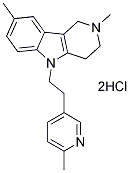
Chemical Structure
Molecular Weight: 392.37
Quality Control
Chemical Information, Storage & Stability
| Molecular Weight | 392.37 | Formula | C21H25N3.2HCl |
Storage (From the date of receipt) | |
|---|---|---|---|---|---|
| CAS No. | 97657-92-6 | -- | Storage of Stock Solutions |
|
|
| Synonyms | N/A | Smiles | CC1=CC2=C(C=C1)N(C3=C2CN(CC3)C)CCC4=CN=C(C=C4)C.Cl.Cl | ||
Solubility
|
In vitro |
DMSO
: 78 mg/mL
(198.79 mM)
Ethanol : 26 mg/mL Water : Insoluble |
Molarity Calculator
|
In vivo |
|||||
In vivo Formulation Calculator (Clear solution)
Step 1: Enter information below (Recommended: An additional animal making an allowance for loss during the experiment)
Step 2: Enter the in vivo formulation (This is only the calculator, not formulation. Please contact us first if there is no in vivo formulation at the solubility Section.)
Calculation results:
Working concentration: mg/ml;
Method for preparing DMSO master liquid: mg drug pre-dissolved in μL DMSO ( Master liquid concentration mg/mL, Please contact us first if the concentration exceeds the DMSO solubility of the batch of drug. )
Method for preparing in vivo formulation: Take μL DMSO master liquid, next addμL PEG300, mix and clarify, next addμL Tween 80, mix and clarify, next add μL ddH2O, mix and clarify.
Method for preparing in vivo formulation: Take μL DMSO master liquid, next add μL Corn oil, mix and clarify.
Note: 1. Please make sure the liquid is clear before adding the next solvent.
2. Be sure to add the solvent(s) in order. You must ensure that the solution obtained, in the previous addition, is a clear solution before proceeding to add the next solvent. Physical methods such as vortex, ultrasound or hot water bath can be used to aid dissolving.
Mechanism of Action
| Targets/IC50/Ki |
GluR
Histamine receptor
5-HT
|
|---|---|
| In vitro |
Latrepirdine increases succinate dehydrogenase activity (MTT-assay), mitochondrial membrane potential (DeltaPsim), and cellular ATP levels in primary mouse cortical neurons and human neuroblastoma cells (SH-SY5Y). Latrepirdine enhances mitochondrial function both in the absence and presence of stress and Dimebon-treated cells are partially protected to maintain cell viability. Latrepirdine leads to enhanced mTOR- and Atg5-dependent autophagy in cultured mammalian cells. latrepirdine stimulates MTOR- and ATG5-dependent autophagy, leading to the reduction of intracellular levels of APP metabolites, including Aβ in cultured cells. Latrepirdine stimulates the degradation of α-syn in differentiated SH-SY5Y neurons, and in mouse brain following chronic administration, in parallel with elevation of the levels of markers of autophagic activity. Latrepirdine increases intracellular ATP levels and glucose transporter 3 translocation to the plasma membrane in primary neuron.
|
| In vivo |
Latrepirdine treatment of TgCRND8 transgenic mice is associated with improved learning behaviour and with a reduction in accumulation of Aβ42 and α-synuclein. Latrepirdine administration results in increased levels of the biomarkers thought to correlate with autophagy activation in the brains of TgCRND8 (APP K670M, N671L, V717F) or wild-type mice, and that treatment is associated with abrogation of behavioural deficit, reduction in Aβ neuropathology, and prevention of autophagic failure among TgCRND8 mice.
|
References |
|
Tech Support
Tel: +1-832-582-8158 Ext:3
If you have any other enquiries, please leave a message.

Products are for research use only. Not for human use. We do not sell to patients.
©Copyright 2013 Selleck Chemicals. All Rights Reserved.