
research use only
2-DG (2-Deoxy-D-glucose) Glycolysis inhibitor
Cat.No.S4701
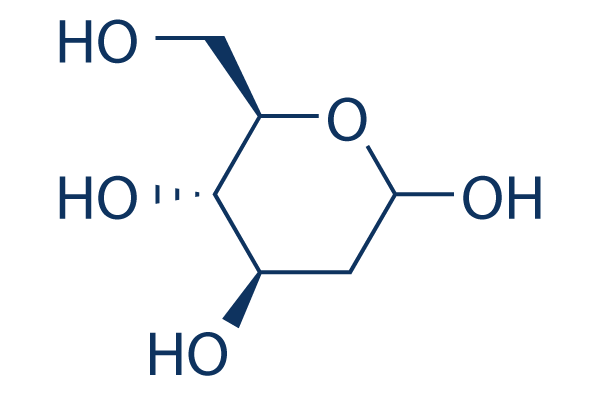
Chemical Structure
Molecular Weight: 164.16
Quality Control
| Related Targets | Dehydrogenase HSP Transferase P450 (e.g. CYP17) PDE phosphatase PPAR Vitamin Mitochondrial Metabolism Drug Metabolite |
|---|---|
| Other Carbohydrate Metabolism Inhibitors | Bromopyruvic acid (3-BP) Lonidamine Dorzagliatin LY2608204 Voglibose 1-Deoxynojirimycin 4',7-Dimethoxy-5-Hydroxyflavone AZD1656 Nodakenetin Kaempferol-3-O-neohesperidoside |
Chemical Information, Storage & Stability
| Molecular Weight | 164.16 | Formula | C6H12O5 |
Storage (From the date of receipt) | |
|---|---|---|---|---|---|
| CAS No. | 154-17-6 | Download SDF | Storage of Stock Solutions |
|
|
| Synonyms | 2-deoxyglucose, NSC 15193, 2-Deoxy-D-arabino-hexose, D-Arabino-2-deoxyhexose | Smiles | C(C=O)C(C(C(CO)O)O)O | ||
Solubility
|
In vitro |
DMSO
: 500 mg/mL
(3045.8 mM)
Warmed with 50°C water bath;
Ultrasonicated;
Water : 83 mg/mL Ethanol : 8 mg/mL |
Molarity Calculator
|
In vivo |
|||||
In vivo Formulation Calculator (Clear solution)
Step 1: Enter information below (Recommended: An additional animal making an allowance for loss during the experiment)
Step 2: Enter the in vivo formulation (This is only the calculator, not formulation. Please contact us first if there is no in vivo formulation at the solubility Section.)
Calculation results:
Working concentration: mg/ml;
Method for preparing DMSO master liquid: mg drug pre-dissolved in μL DMSO ( Master liquid concentration mg/mL, Please contact us first if the concentration exceeds the DMSO solubility of the batch of drug. )
Method for preparing in vivo formulation: Take μL DMSO master liquid, next addμL PEG300, mix and clarify, next addμL Tween 80, mix and clarify, next add μL ddH2O, mix and clarify.
Method for preparing in vivo formulation: Take μL DMSO master liquid, next add μL Corn oil, mix and clarify.
Note: 1. Please make sure the liquid is clear before adding the next solvent.
2. Be sure to add the solvent(s) in order. You must ensure that the solution obtained, in the previous addition, is a clear solution before proceeding to add the next solvent. Physical methods such as vortex, ultrasound or hot water bath can be used to aid dissolving.
Mechanism of Action
| Targets/IC50/Ki |
glycolysis
|
|---|---|
| In vitro |
2-Deoxy-D-glucose (2-DG) activates AKT function through phosphatidylinositol 3-kinase (PI3K) and is independent of glycolysis or mTOR inhibition. Its treatments disrupt the binding between insulin-like growth factor 1 (IGF-1) and IGF-binding protein 3 (IGFBP3) so that the free form of IGF-1 could be released from the IGF-1·IGFBP3 complex to activate IGF-1 receptor (IGF1R) signalling. 2-DG-induced activation of many survival pathways can be jointly attenuated through IGF1R inhibition. This compound also induces time- and dose-dependent ERK phosphorylation. It is readily transported into cells and is phosphorylated by hexokinase, but cannot be metabolised further and accumulates in the cell. This leads to ATP depletion and the induction of cell-death. 2DG significantly suppresses proliferation, causes apoptosis and reduces migration of murine endothelial cells, inhibiting formation of lamellipodia and filopodia and causing disorganisation of F-actin filaments in murine endothelial cell.
|
| In vivo |
Treatment of cancer patients with relatively high doses of 2-Deoxy-D-glucose (2-DG) (greater than 200 mg/kg) was largely ineffective in managing tumour growth. Side effects of this compound included elevated blood glucose levels, progressive weight loss with lethargy, and behavioural symptoms of hypoglycaemia. It enhances isoflurane-induced loss of righting reflex in mice. By reducing Metabolism, 2-DG treatment can decrease body temperature in rodent, enhancing sensitivity to anaesthetics. A diet containing it significantly increased serum ketone body level and brain expression of enzymes required for ketone body Metabolism. The 2-DG-induced maintenance of mitochondrial bioenergetics was paralleled by simultaneous reduction in oxidative stress. Further, treated mice exhibited a significant reduction of both amyloid precursor protein (APP) and amyloid beta (Aβ) oligomers, which was paralleled by significantly increased α-secretase and decreased γ-secretase expression, indicating that this compound induced a shift towards a non-amyloidogenic pathway. It increased expression of genes involved in Aβ clearance pathways, degradation, sequestering, and transport. Concomitant with increased bioenergetic capacity and reduced β-amyloid burden, 2-DG significantly increased expression of neurotrophic growth factors, BDNF and NGF, thus reduces pathology in female mouse model of Alzheimer's disease.
|
References |
|
Clinical Trial Information
(data from https://clinicaltrials.gov, updated on 2024-05-22)
| NCT Number | Recruitment | Conditions | Sponsor/Collaborators | Start Date | Phases |
|---|---|---|---|---|---|
| NCT02558140 | Completed | Neoplasms |
Hoffmann-La Roche |
October 11 2015 | Phase 1 |
| NCT01998841 | Completed | Alzheimer''s Disease |
Genentech Inc.|Banner Alzheimer''s Institute|National Institute on Aging (NIA) |
December 20 2013 | Phase 2 |
Tech Support
Tel: +1-832-582-8158 Ext:3
If you have any other enquiries, please leave a message.

Products are for research use only. Not for human use. We do not sell to patients.
©Copyright 2013 Selleck Chemicals. All Rights Reserved.