
research use only
P22077 DUB inhibitor
Cat.No.S7133
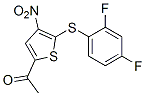
Chemical Structure
Molecular Weight: 315.32
Quality Control
| Related Targets | Proteasome E1 Activating E3 Ligase p97 SUMO E2 conjugating |
|---|---|
| Other DUB Inhibitors | PR-619 P5091 IU1 b-AP15 ML323 LDN-57444 VLX1570 TCID EOAI3402143 ML364 |
Chemical Information, Storage & Stability
| Molecular Weight | 315.32 | Formula | C12H7F2NO3S2 |
Storage (From the date of receipt) | |
|---|---|---|---|---|---|
| CAS No. | 1247819-59-5 | Download SDF | Storage of Stock Solutions |
|
|
| Synonyms | N/A | Smiles | CC(=O)C1=CC(=C(S1)SC2=C(C=C(C=C2)F)F)[N+](=O)[O-] | ||
Solubility
|
In vitro |
DMSO
: 63 mg/mL
(199.79 mM)
Ethanol : 1 mg/mL Water : Insoluble |
Molarity Calculator
|
In vivo |
|||||
In vivo Formulation Calculator (Clear solution)
Step 1: Enter information below (Recommended: An additional animal making an allowance for loss during the experiment)
Step 2: Enter the in vivo formulation (This is only the calculator, not formulation. Please contact us first if there is no in vivo formulation at the solubility Section.)
Calculation results:
Working concentration: mg/ml;
Method for preparing DMSO master liquid: mg drug pre-dissolved in μL DMSO ( Master liquid concentration mg/mL, Please contact us first if the concentration exceeds the DMSO solubility of the batch of drug. )
Method for preparing in vivo formulation: Take μL DMSO master liquid, next addμL PEG300, mix and clarify, next addμL Tween 80, mix and clarify, next add μL ddH2O, mix and clarify.
Method for preparing in vivo formulation: Take μL DMSO master liquid, next add μL Corn oil, mix and clarify.
Note: 1. Please make sure the liquid is clear before adding the next solvent.
2. Be sure to add the solvent(s) in order. You must ensure that the solution obtained, in the previous addition, is a clear solution before proceeding to add the next solvent. Physical methods such as vortex, ultrasound or hot water bath can be used to aid dissolving.
Mechanism of Action
| Targets/IC50/Ki |
USP7
(Cell-free assay) 8.6 μM
USP47
8.74 μM(EC50)
|
|---|---|
| In vitro |
P22077 is an analog of the recently discovered USP7 inhibitor P5091. This compound has negligible activity versus DEN1 and SENP2core over the concentration range tested, but inhibits USP7 with an IC50 of 8 μM. The inhibitory activities of this chemical in vitro against a panel of DUBs, cysteine proteases, and other families of proteolytic enzymes demonstrate that it inhibits USP7 and the closely related DUB USP47. It inhibits a smaller subset of DUBs at a concentration of 15–45 mM in cell lysates. This compound induces (tumor) cell death with EC50 values in the low micromolar range. Its inhibition exhibited changes in ubiquitylated protein levels that are distinct from the broad specificity inhibitor. Furthermore, quantitative MS suggestes the E3 ubiquitin ligase components RBX1, DCAF7, DCAF11, and the DNA damage binding protein 1 (DDB1) to be reduced upon cellular treatment with this chemical. |
| Kinase Assay |
UbL-EKL assays
|
|
Unless stated otherwise, recombinant isopeptidase is mixed with UbL-EKL and EKLsubstrate I to final concentrations of 20, 50, and 20 nM, respectively, in a total volume of 100 μL in a well in a black-walled 96-well plate. All dilutions are performed in isopeptidase assay buffer (20 mM Tris-HCl, pH 8.0, 2 mM CaCl2, and 2 mM β-mercaptoethanol). The increase in fluorescence intensity over time is determined on a Perkin Elmer Envision fluorescence plate reader with excitation and emission filters corresponding to the fluorescence resonance energy transfer peptide utilized. Unless stated otherwise, net relative fluorescence units (RFUs) are determined by subtracting the blank RFU value (20 nM EKL substrate I or 100 nM EKL substrate II in isopeptidase assay buffer) from each data point. SENP2core, SUMO3-EKL sensitivity experiments are performed by mixing 0–100 fM SENP2core with 50 nM SUMO3-EKL, and 100 nM EKL substrate I in a total volume of 100 μL as above.
|
|
| In vivo |
Inhibition of USP7 by P22077 also inhibits melanoma tumour growth in vivo. |
References |
|
Tech Support
Tel: +1-832-582-8158 Ext:3
If you have any other enquiries, please leave a message.

Products are for research use only. Not for human use. We do not sell to patients.
©Copyright 2013 Selleck Chemicals. All Rights Reserved.