
research use only
Ozanimod S1P Receptor modulator
Cat.No.S7952
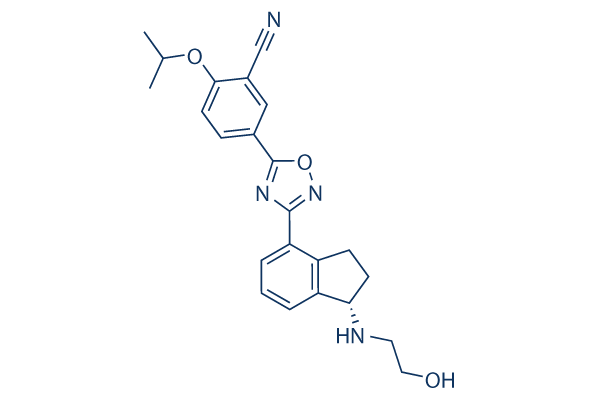
Chemical Structure
Molecular Weight: 404.46
Quality Control
| Related Targets | CXCR Hedgehog/Smoothened PKA Adrenergic Receptor AChR 5-HT Receptor Histamine Receptor Dopamine Receptor Ras KRas |
|---|---|
| Other S1P Receptor Inhibitors | JTE 013 PF 429242 CAY10444 CYM5541 CYM-5520 SEW 2871 SLF1081851 hydrochloride CYM50308 MP-A08 Etrasimod(APD334) |
Chemical Information, Storage & Stability
| Molecular Weight | 404.46 | Formula | C23H24N4O3 |
Storage (From the date of receipt) | |
|---|---|---|---|---|---|
| CAS No. | 1306760-87-1 | Download SDF | Storage of Stock Solutions |
|
|
| Synonyms | RPC1063 | Smiles | CC(C)OC1=C(C=C(C=C1)C2=NC(=NO2)C3=C4CCC(C4=CC=C3)NCCO)C#N | ||
Solubility
|
In vitro |
DMSO
: 40 mg/mL
(98.89 mM)
Ethanol : 10 mg/mL Water : Insoluble |
Molarity Calculator
|
In vivo |
|||||
In vivo Formulation Calculator (Clear solution)
Step 1: Enter information below (Recommended: An additional animal making an allowance for loss during the experiment)
Step 2: Enter the in vivo formulation (This is only the calculator, not formulation. Please contact us first if there is no in vivo formulation at the solubility Section.)
Calculation results:
Working concentration: mg/ml;
Method for preparing DMSO master liquid: mg drug pre-dissolved in μL DMSO ( Master liquid concentration mg/mL, Please contact us first if the concentration exceeds the DMSO solubility of the batch of drug. )
Method for preparing in vivo formulation: Take μL DMSO master liquid, next addμL PEG300, mix and clarify, next addμL Tween 80, mix and clarify, next add μL ddH2O, mix and clarify.
Method for preparing in vivo formulation: Take μL DMSO master liquid, next add μL Corn oil, mix and clarify.
Note: 1. Please make sure the liquid is clear before adding the next solvent.
2. Be sure to add the solvent(s) in order. You must ensure that the solution obtained, in the previous addition, is a clear solution before proceeding to add the next solvent. Physical methods such as vortex, ultrasound or hot water bath can be used to aid dissolving.
Mechanism of Action
| Targets/IC50/Ki |
S1P1R
(Cell-free assay) 0.41 nM(EC50)
S1P5R
(Cell-free assay) 11 nM(EC50)
|
|---|---|
| In vitro |
In S1P1R-HEK293T cells, Ozanimod induces sustained S1P1R internalization and degradation. |
| Kinase Assay |
In vitro pharmacology assays
|
|
Cell signalling assays used the LiveBLAzer-FRET B/G assay to detect cAMP (S1P1R) or
β-arrestin signalling (S1P4R). Assays are performed in 384-well plates in triplicate according to manufacturer directions. Compound stocks are stored at 10 mM in 100% DMSO at -80°C, and initially diluted 1:10 with 20% (2-hydoxypropyl)-β-cyclodextrin. A 10-point dose response curve is generated at 40-times the final assay concentration in 10 mM Hepes pH 7.4, containing 0.1% Pluronic F-127. For the S1P1R assay, 80 μM forskolin is included in the diluent. Briefly, 104 cells/well are incubated with a dose response of ligand at 37°C for 4 hrs. CC4-AM substrate and probenecid are added and incubated at 37°C for a further 2 hrs and analyzed with a SpectramaxM5. For S1P1R cAMP assays, data is normalized to the maximum fluorescence generated by 2 μM forskolin. For GTPγS binding assays, 1-5μg/well of membrane protein is incubated with 10 μM GDP, 100-500 μg/well Wheat Germ Agglutinin PVT SPA beads in 50 mM HEPES, 100 mM NaCl, 10 mM MgCl2, 20 μg/ml saponin and 0.1% fatty acid free BSA for 15 minutes in 96-well plates. After the addition of compound and 200 pM GTP [35S] 1250Ci/mmol), the plates are incubated for 120 minutes and centrifuged at 300g for 5 minutes. Radioactivity is detected with a TopCount Instrument. All data is fit with a four parameter variable slope non-linear regression (GraphPad Prism) to generate half-maximal effective concentration (EC50) and maximum efficacy relative to S1P.
|
|
| In vivo |
In vivo, Ozanimod shows high oral bioavailability and volume of distribution. In a MOG-induced EAE mouse model, this compound (3 mg/kg, p.o.) suppresses clinical symptoms. In a rat TNBS model of inflammatory bowel disease, it (1.2 mg/kg, p.o.) inhibits clinical and histological disease scores. In a Naïve CD4+CD45Rbhi T cell adoptive transfer model, this chemical (1.2 mg/kg, p.o.) also significantly reduced disease severity as assessed by measuring the degree of inflammation, gland loss, hyperplasia, neutrophil infiltrate and mucosal thickness. |
References |
Clinical Trial Information
(data from https://clinicaltrials.gov, updated on 2024-05-22)
| NCT Number | Recruitment | Conditions | Sponsor/Collaborators | Start Date | Phases |
|---|---|---|---|---|---|
| NCT06408259 | Not yet recruiting | Multiple Sclerosis Relapsing-Remitting |
Celgene |
July 9 2024 | Phase 3 |
| NCT06334094 | Not yet recruiting | Multiple Sclerosis |
The University of Texas at Dallas|Texas Institute for Neurological Disorders |
June 1 2024 | Phase 4 |
| NCT06188637 | Not yet recruiting | Ulcerative Colitis |
Geert D''Haens|Bristol-Myers Squibb|Academisch Medisch Centrum - Universiteit van Amsterdam (AMC-UvA) |
March 1 2024 | Phase 4 |
| NCT05470985 | Recruiting | Crohn Disease |
Bristol-Myers Squibb |
August 22 2023 | Phase 2|Phase 3 |
| NCT05811416 | Recruiting | Relapsing-remitting Multiple Sclerosis (RRMS) |
Bristol-Myers Squibb |
June 14 2023 | -- |
Tech Support
Tel: +1-832-582-8158 Ext:3
If you have any other enquiries, please leave a message.

Products are for research use only. Not for human use. We do not sell to patients.
©Copyright 2013 Selleck Chemicals. All Rights Reserved.