
research use only
JTE 013 S1P Receptor antagonist
Cat.No.S7182
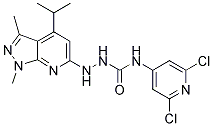
Chemical Structure
Molecular Weight: 408.29
Quality Control
| Related Targets | CXCR Hedgehog/Smoothened PKA Adrenergic Receptor AChR 5-HT Receptor Histamine Receptor Dopamine Receptor Ras KRas |
|---|---|
| Other S1P Receptor Inhibitors | PF 429242 CAY10444 CYM5541 CYM-5520 SEW 2871 SLF1081851 hydrochloride CYM50308 MP-A08 Etrasimod(APD334) K145 |
Chemical Information, Storage & Stability
| Molecular Weight | 408.29 | Formula | C17H19Cl2N7O |
Storage (From the date of receipt) | |
|---|---|---|---|---|---|
| CAS No. | 383150-41-2 | Download SDF | Storage of Stock Solutions |
|
|
| Synonyms | N/A | Smiles | CC1=NN(C2=C1C(=CC(=N2)NNC(=O)NC3=CC(=NC(=C3)Cl)Cl)C(C)C)C | ||
Solubility
|
In vitro |
DMSO
: 81 mg/mL
(198.38 mM)
Ethanol : 34 mg/mL Water : Insoluble |
Molarity Calculator
|
In vivo |
|||||
In vivo Formulation Calculator (Clear solution)
Step 1: Enter information below (Recommended: An additional animal making an allowance for loss during the experiment)
Step 2: Enter the in vivo formulation (This is only the calculator, not formulation. Please contact us first if there is no in vivo formulation at the solubility Section.)
Calculation results:
Working concentration: mg/ml;
Method for preparing DMSO master liquid: mg drug pre-dissolved in μL DMSO ( Master liquid concentration mg/mL, Please contact us first if the concentration exceeds the DMSO solubility of the batch of drug. )
Method for preparing in vivo formulation: Take μL DMSO master liquid, next addμL PEG300, mix and clarify, next addμL Tween 80, mix and clarify, next add μL ddH2O, mix and clarify.
Method for preparing in vivo formulation: Take μL DMSO master liquid, next add μL Corn oil, mix and clarify.
Note: 1. Please make sure the liquid is clear before adding the next solvent.
2. Be sure to add the solvent(s) in order. You must ensure that the solution obtained, in the previous addition, is a clear solution before proceeding to add the next solvent. Physical methods such as vortex, ultrasound or hot water bath can be used to aid dissolving.
Mechanism of Action
| Targets/IC50/Ki |
S1PR2(human)
(in CHO cells) 17 nM
S1PR2(rat)
(in CHO cells) 22 nM
|
|---|---|
| In vitro |
JTE-013 reverses the inhibitory effects of S1P2 signalling on cell migration of vascular ECs and smooth muscle cells. It regulates endothelial tight junctions and barrier function in vitro. Blockage of S1P2 signalling by JTE-013 significantly enhances the effects of S1P on the increase of TEER, an in vitro measurement of endothelial integrity, as well as the formation of TJs in senescent ECs.
|
| In vivo |
JTE-013 inhibition of S1P2 significantly inhibits microvascular permeability in an in vivo animal model. JTE-013 modulates the responses of brain endothelium by inhibiting cerebrovascular permeability, the development of intracerebral haemorrhage, and neurovascular injury in an experimental model of stroke. JTE-013 reduced mast cell activation, airway infiltration, and the serum levels of histamine and several cytokines in vitro and in vivo studies. In a murine model, JTE-013 suppresses streptozotocin-induced blood glucose increases, pancreatic b cell apoptosis, and the incidence of diabetes. In a New Zealand obese diabetic mouse model under high-fat diet conditions, it protected pancreatic b cells. Treatment with JTE-013 also reduces plasma levels of IL-1b and IL-18 (endotoxin-induced inflammatory cytokines) in ApoE−/− mice and S1P2 gene deficiency reduces atherosclerosis. The compound offers a novel means of treating inflammatory disorders, such as, atherosclerosis and sepsis.
|
References |
|
Applications
| Methods | Biomarkers | Images | PMID |
|---|---|---|---|
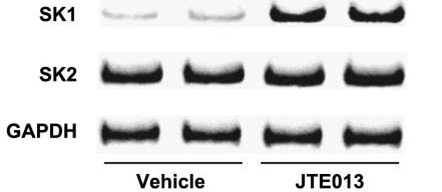
| Western blot | SK1 / SK2 |
|
22095950 |
Tech Support
Tel: +1-832-582-8158 Ext:3
If you have any other enquiries, please leave a message.

Products are for research use only. Not for human use. We do not sell to patients.
©Copyright 2013 Selleck Chemicals. All Rights Reserved.