
research use only
Ciproxifan Maleate Histamine Receptor antagonist
Cat.No.S2813
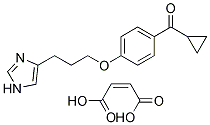
Chemical Structure
Molecular Weight: 386.4
Quality Control
| Related Targets | Adrenergic Receptor AChR 5-HT Receptor COX Calcium Channel Dopamine Receptor GABA Receptor TRP Channel Cholinesterase (ChE) GluR |
|---|---|
| Other Histamine Receptor Inhibitors | GSK2879552 Dihydrochloride JNJ-7777120 Ebastine Mianserin HCl Astemizole Lafutidine Mizolastine Rupatadine Fumarate Betahistine 2HCl Levodropropizine |
Chemical Information, Storage & Stability
| Molecular Weight | 386.4 | Formula | C16H18N2O2.C4H4O4 |
Storage (From the date of receipt) | |
|---|---|---|---|---|---|
| CAS No. | 184025-19-2 | Download SDF | Storage of Stock Solutions |
|
|
| Synonyms | FUB 359 | Smiles | C1CC1C(=O)C2=CC=C(C=C2)OCCCC3=CN=CN3.C(=CC(=O)O)C(=O)O | ||
Solubility
|
In vitro |
DMSO
: 54 mg/mL
(139.75 mM)
Ethanol : 54 mg/mL Water : 1 mg/mL |
Molarity Calculator
|
In vivo |
|||||
In vivo Formulation Calculator (Clear solution)
Step 1: Enter information below (Recommended: An additional animal making an allowance for loss during the experiment)
Step 2: Enter the in vivo formulation (This is only the calculator, not formulation. Please contact us first if there is no in vivo formulation at the solubility Section.)
Calculation results:
Working concentration: mg/ml;
Method for preparing DMSO master liquid: mg drug pre-dissolved in μL DMSO ( Master liquid concentration mg/mL, Please contact us first if the concentration exceeds the DMSO solubility of the batch of drug. )
Method for preparing in vivo formulation: Take μL DMSO master liquid, next addμL PEG300, mix and clarify, next addμL Tween 80, mix and clarify, next add μL ddH2O, mix and clarify.
Method for preparing in vivo formulation: Take μL DMSO master liquid, next add μL Corn oil, mix and clarify.
Note: 1. Please make sure the liquid is clear before adding the next solvent.
2. Be sure to add the solvent(s) in order. You must ensure that the solution obtained, in the previous addition, is a clear solution before proceeding to add the next solvent. Physical methods such as vortex, ultrasound or hot water bath can be used to aid dissolving.
Mechanism of Action
| Targets/IC50/Ki |
Histamine H3 receptor
9.2 nM
|
|---|---|
| In vitro |
Ciproxifan inhibits [3H]HA release from synaptosomes with Ki of 0.5 nM. Ciproxifan inhibits the binding of [125I]iodoproxyfan at the brain H3 receptor with Ki of 0.7 nM. Ciproxifan displays high affinity at H3 receptor but shows low apparent affinity at other receptor subtypes as evaluated in functional tests on isolated organs (histamine H1 and H2, muscarinic M3, adrenergic α1D and β1, serotonin 5-HT1B, 5-HT2A, 5-HT3 and 5-HT4).
|
| In vivo |
Ciproxifan intravenously injected at dose of 1 mg/kg decreases the H3-receptor ligand concentration in serum in Male Swiss mice, with half-times of distribution phase of 13min and elimination phase of 87 min, respectively. Ciproxifan (1 mg/kg, p.o.) rises brain t-MeHA level rapidly in Male Swiss mice, being already significantly increased after 30 min, reaching a plateau between 90 and 180 min and still remaining enhanced after 270 min. Ciproxifan leads to ED50 values of 0.23 mg/kg in cerebral cortex, 0.28 mg/kg in striatum and 0.30 mg/kg in hypothalamus in Male Wistar rats. Ciproxifan (3 mg/kg, i.p.) significantly increases choice accuracy as evaluated in the five-choice task performed using a short stimulus duration. Ciproxifan (0.15-2 mg/kg, p.o.) induces marked signs of neocortical electroencephalogram activation manifested by enhanced fast-rhythms density and an almost total waking state in cats. Ciproxifan (10 mg/kg i.p.) enhances prepulse inhibition in the DBA/2 strain mice. Ciproxifan (3 mg/kg i.p.) alleviates hyperactivity and cognitive deficits in the APP Tg2576 mouse model of Alzheimer's disease. Ciproxifan (3 mg/kg i.p.) improves accuracy and decreased impulsivity in adult male hooded Lister rats.
|
References |
|
Tech Support
Tel: +1-832-582-8158 Ext:3
If you have any other enquiries, please leave a message.

Products are for research use only. Not for human use. We do not sell to patients.
©Copyright 2013 Selleck Chemicals. All Rights Reserved.