
research use only
CH5132799 PI3K inhibitor
Cat.No.S2699
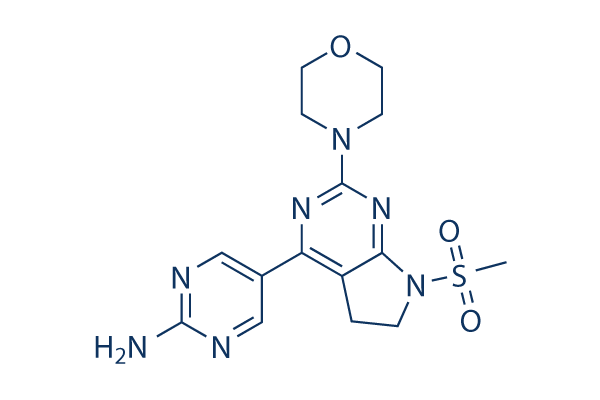
Chemical Structure
Molecular Weight: 377.42
Quality Control
| Related Targets | Akt mTOR GSK-3 ATM/ATR DNA-PK AMPK PDPK1 PTEN PP2A PDK |
|---|---|
| Other PI3K Inhibitors | GDC-0077 (Inavolisib) SAR405 Quercetin (Sophoretin) LY294002 XL147 analogue Tersolisib (STX-478) Buparlisib (BKM120) 740 Y-P (PDGFR 740Y-P) GO-203 TFA Eganelisib (IPI-549) |
Chemical Information, Storage & Stability
| Molecular Weight | 377.42 | Formula | C15H19N7O3S |
Storage (From the date of receipt) | |
|---|---|---|---|---|---|
| CAS No. | 1007207-67-1 | Download SDF | Storage of Stock Solutions |
|
|
| Synonyms | MEN1611, PA799 | Smiles | CS(=O)(=O)N1CCC2=C(N=C(N=C21)N3CCOCC3)C4=CN=C(N=C4)N | ||
Solubility
|
In vitro |
DMSO
: 12 mg/mL
(31.79 mM)
Water : Insoluble Ethanol : Insoluble |
Molarity Calculator
|
In vivo |
|||||
In vivo Formulation Calculator (Clear solution)
Step 1: Enter information below (Recommended: An additional animal making an allowance for loss during the experiment)
Step 2: Enter the in vivo formulation (This is only the calculator, not formulation. Please contact us first if there is no in vivo formulation at the solubility Section.)
Calculation results:
Working concentration: mg/ml;
Method for preparing DMSO master liquid: mg drug pre-dissolved in μL DMSO ( Master liquid concentration mg/mL, Please contact us first if the concentration exceeds the DMSO solubility of the batch of drug. )
Method for preparing in vivo formulation: Take μL DMSO master liquid, next addμL PEG300, mix and clarify, next addμL Tween 80, mix and clarify, next add μL ddH2O, mix and clarify.
Method for preparing in vivo formulation: Take μL DMSO master liquid, next add μL Corn oil, mix and clarify.
Note: 1. Please make sure the liquid is clear before adding the next solvent.
2. Be sure to add the solvent(s) in order. You must ensure that the solution obtained, in the previous addition, is a clear solution before proceeding to add the next solvent. Physical methods such as vortex, ultrasound or hot water bath can be used to aid dissolving.
Mechanism of Action
| Targets/IC50/Ki |
PI3Kα
14 nM
PI3Kγ
36 nM
PI3Kβ
0.12 μM
PI3Kδ
0.50 μM
|
|---|---|
| In vitro |
CH5132799 selectively inhibits class I PI3Ks, PI3Kα (IC50 = 0.014 μM ), PI3Kβ (IC50 = 0.12 μM ), PI3Kδ (IC50 = 0.50 μM ), PI3Kγ (IC50 = 0.036 μM ), but shows less inhibition of class II PI3Ks, class III PI3k and mTOR and also no inhibitory activity (IC50 > 10 μM) against 26 protein kinases. This compound exhibits more inhibitory activities against PI3Kα with oncogenic mutations E542K (IC50 = 6.7 nM), E545K (IC50 = 6.7 nM) and H1047R (IC50 = 5.6 nM) than wild-type PI3Kα. This chemical treated breast cancer KPL-4 cells, which harbour the PIK3CA mutation, phosphorylation of Akt and its direct substrates, PRAS40 and FoxO1/3a and phosphorylation of downstream factors, including S6K, S6 and 4E-BP1, are effectively suppressed. Cancer cell lines harbouring PIK3CA mutations are significantly sensitive to this compound In human tumour cell lines with PI3K pathway activation by mutation, it shows potent antiproliferative activity [HCT116(CRC): IC50 = 0.20 lM, KPL-4(BC):13 IC50 = 0.032 lM, T-47D(BC): IC50 = 0.056 lM, SK-OV-3(Ovarian): IC50 = 0.12 lM]. It effectively suppresses phosphorylation of AKT in KPL-4 cells.
|
| Kinase Assay |
PI3K Assay
|
|
The E542K, E545K, and H1047R mutants of PI3Kα are prepared with an overlapped extension-polymerase chain reaction. Glutathione S-transferase-tagged PI3Kα mutants and His-tagged p85α are co-expressed with BAC-TO-BAC Baculovirus Expression System. The inhibitory activities of this compound on PI3Kα (p110α/p85α), PI3Kβ(p110β/p85α), PI3Kδ (p110δ/p85α), PI3Kγ (p110γ), PI3KC2α, PI3KC2β, Vps34, and PI3Kα mutants are determined by Adapta Universal Kinase Assay Kit. Time-resolved fluorescence is measured with an EnVision HTS microplate reader. IC50 values are calculated using XLfit.
|
|
| In vivo |
CH5132799 shows potent in vivo antitumor activity in several different xenograft models with PIK3CA mutations. This compound overcomes mTORC1 inhibition-mediated Akt activation and regrowth of xenograft tumour by long-term everolimus administration. It is a clinical candidate that shows excellent oral bioavailability (BA) (101% in mouse), human liver microsomal stability and in vivo antitumor activity in the PC-3 xenograft model (TGI: 101% at 25 mg/kg, po, q.d. × 11 days). This chemical exhibits good oral BA in mouse, rat, monkey and dog (F: 54.2-101%). In a human breast cancer (KPL-4: PI3Ka H1047R) xenograft model in mice, oral treatment with this compound (12.5 mg/kg, q.d.) shows strong tumour regression. The strong regression is maintained during the 6-week administration, even in the intermittent dosing schedule (q.d., 2 weeks on/1 week off; q.d., 5 days on/2 days off), suggesting that a flexible administration schedule can be applicable in the clinic.
|
References |
|
Clinical Trial Information
(data from https://clinicaltrials.gov, updated on 2024-05-22)
| NCT Number | Recruitment | Conditions | Sponsor/Collaborators | Start Date | Phases |
|---|---|---|---|---|---|
| NCT01222546 | Completed | Solid Tumors |
Chugai Pharma Europe Ltd. |
August 2010 | Phase 1 |
Tech Support
Tel: +1-832-582-8158 Ext:3
If you have any other enquiries, please leave a message.

Products are for research use only. Not for human use. We do not sell to patients.
©Copyright 2013 Selleck Chemicals. All Rights Reserved.