
research use only
(+)-Catechin Antioxidant chemical
Cat.No.S4722
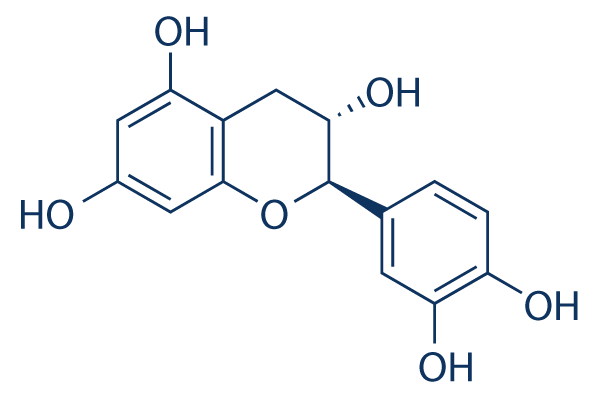
Chemical Structure
Molecular Weight: 290.27
Quality Control
| Related Targets | PD-1/PD-L1 CXCR STING AhR Immunology & Inflammation related CD markers Interleukins Anti-infection COX Histamine Receptor |
|---|---|
| Other Antioxidant Inhibitors | Elamipretide (SS-31, MTP-131) Tangeretin Silymarin Oleuropein (-)Epicatechin Hydroxygenkwanin Syringic acid Cocoa Extract Sesamol Flavanone |
Chemical Information, Storage & Stability
| Molecular Weight | 290.27 | Formula | C15H14O6 |
Storage (From the date of receipt) | 3 years -20°C powder (seal) |
|---|---|---|---|---|---|
| CAS No. | 154-23-4 | Download SDF | Storage of Stock Solutions |
|
|
| Synonyms | Cianidanol, Catechinic acid, Catechuic acid, Catechin | Smiles | C1C(C(OC2=CC(=CC(=C21)O)O)C3=CC(=C(C=C3)O)O)O | ||
Solubility
|
In vitro |
DMSO
: 58 mg/mL
(199.81 mM)
Ethanol : 58 mg/mL Water : 1.8 mg/mL |
Molarity Calculator
|
In vivo |
|||||
In vivo Formulation Calculator (Clear solution)
Step 1: Enter information below (Recommended: An additional animal making an allowance for loss during the experiment)
Step 2: Enter the in vivo formulation (This is only the calculator, not formulation. Please contact us first if there is no in vivo formulation at the solubility Section.)
Calculation results:
Working concentration: mg/ml;
Method for preparing DMSO master liquid: mg drug pre-dissolved in μL DMSO ( Master liquid concentration mg/mL, Please contact us first if the concentration exceeds the DMSO solubility of the batch of drug. )
Method for preparing in vivo formulation: Take μL DMSO master liquid, next addμL PEG300, mix and clarify, next addμL Tween 80, mix and clarify, next add μL ddH2O, mix and clarify.
Method for preparing in vivo formulation: Take μL DMSO master liquid, next add μL Corn oil, mix and clarify.
Note: 1. Please make sure the liquid is clear before adding the next solvent.
2. Be sure to add the solvent(s) in order. You must ensure that the solution obtained, in the previous addition, is a clear solution before proceeding to add the next solvent. Physical methods such as vortex, ultrasound or hot water bath can be used to aid dissolving.
Mechanism of Action
| Targets/IC50/Ki |
COX-1
(Cell-based assay) 80 μM
COX-2
(Cell-based assay) 130 μM
|
|---|---|
| In vitro |
The catechin flavonoid reduces proliferation and induces apoptosis of murine lymphoma cells LB02 through modulation of antiapoptotic proteins. Treatment of human prostate cancer cells with catechin induces apoptosis and results in effects on a variety of survival signals suggesting the potential of these compounds as chemopreventive agents for prostate cancer. Catechin is well known to inhibit cyclooxygenase activity with reported IC50 values ranging from 40 μM to 943 μM. It has also been reported to act as an inhibitor of COX-1 and COX-2 with IC50 of about 80 µM and 130 μM.
|
| In vivo |
Dietary catechin significantly delayed tumour onset. Continued intake of catechin, a potential Antioxidant, prevents memory regression and DNA oxidative damage in senescence-accelerated (SAMP10) mice. It does not prolong the lifetime of SAMP10 mice, but it does delay brain senescence. (+)-Catechin inhibits intestinal tumour formation and suppresses Focal adhesion kinase activation in the Min/+ Mouse.
|
References |
|
Tech Support
Tel: +1-832-582-8158 Ext:3
If you have any other enquiries, please leave a message.

Products are for research use only. Not for human use. We do not sell to patients.
©Copyright 2013 Selleck Chemicals. All Rights Reserved.