
research use only
ABX-1431 Lipase inhibitor
Cat.No.S8823
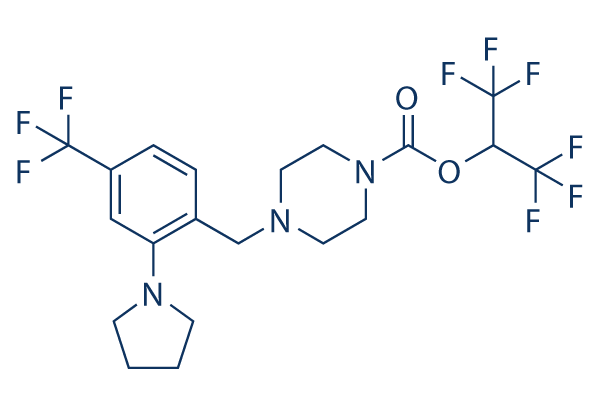
Chemical Structure
Molecular Weight: 507.39
Quality Control
| Related Targets | Dehydrogenase HSP Transferase P450 (e.g. CYP17) PDE phosphatase PPAR Vitamin Carbohydrate Metabolism Mitochondrial Metabolism |
|---|---|
| Other Lipase Inhibitors | Tanshinone IIA Atglistatin JZL184 Pristimerin XEN445 Cetilistat Pancreatin Schaftoside URB602 Ibrolipim |
Chemical Information, Storage & Stability
| Molecular Weight | 507.39 | Formula | C20H22F9N3O2 |
Storage (From the date of receipt) | 3 years -20°C powder |
|---|---|---|---|---|---|
| CAS No. | 1446817-84-0 | -- | Storage of Stock Solutions |
|
|
| Synonyms | N/A | Smiles | C1CCN(C1)C2=C(C=CC(=C2)C(F)(F)F)CN3CCN(CC3)C(=O)OC(C(F)(F)F)C(F)(F)F | ||
Solubility
|
In vitro |
DMSO
: 100 mg/mL
(197.08 mM)
Ethanol : 100 mg/mL Water : Insoluble |
Molarity Calculator
|
In vivo |
|||||
In vivo Formulation Calculator (Clear solution)
Step 1: Enter information below (Recommended: An additional animal making an allowance for loss during the experiment)
Step 2: Enter the in vivo formulation (This is only the calculator, not formulation. Please contact us first if there is no in vivo formulation at the solubility Section.)
Calculation results:
Working concentration: mg/ml;
Method for preparing DMSO master liquid: mg drug pre-dissolved in μL DMSO ( Master liquid concentration mg/mL, Please contact us first if the concentration exceeds the DMSO solubility of the batch of drug. )
Method for preparing in vivo formulation: Take μL DMSO master liquid, next addμL PEG300, mix and clarify, next addμL Tween 80, mix and clarify, next add μL ddH2O, mix and clarify.
Method for preparing in vivo formulation: Take μL DMSO master liquid, next add μL Corn oil, mix and clarify.
Note: 1. Please make sure the liquid is clear before adding the next solvent.
2. Be sure to add the solvent(s) in order. You must ensure that the solution obtained, in the previous addition, is a clear solution before proceeding to add the next solvent. Physical methods such as vortex, ultrasound or hot water bath can be used to aid dissolving.
Mechanism of Action
| Targets/IC50/Ki |
hMGLL
14 nM
mMGLL
27 nM
|
|---|---|
| In vitro |
ABX-1431 is a potent human MGLL inhibitor (average IC50 = 0.014 μM) with >100-fold selectivity against ABHD6 and >200-fold selectivity against PLA2G7. Treatment of intact human PC3 cells with this compound following a 30 min inhibitor incubation time causes concentration dependent inhibition of MGLL activity with an IC50 value of 0.0022 μM, which is ∼6-fold more potent than that observed in vitro. This chemical inhibits MGLL via carbamoylation of the catalytic nucleophile Ser122. |
| In vivo |
Pharmacokinetic analysis in rats and dogs of ABX-1431 indicate low to moderate systemic clearance, moderate volume of distribution, and high oral bioavailability (64% in rat, 57% in dog). While this compound is stable in human and dog plasma, it is not stable in rat plasma. This chemical is a potent and selective inhibitor of MGLL in mouse and rat brain in vivo. It inhibits MGLL activity with an ED50 of 0.5-1.4 mg/kg (po) and dose-dependently increases brain 2-AG levels in mouse brain. A rat inflammatory pain model is used to assess the pharmacodynamics effect. The compound demonstrates potent antinociceptive effects in a formalin paw test at a dose that produced near complete MGLL inhibition and maximal elevation of 2-AG. |
References |
|
Clinical Trial Information
(data from https://clinicaltrials.gov, updated on 2024-05-22)
| NCT Number | Recruitment | Conditions | Sponsor/Collaborators | Start Date | Phases |
|---|---|---|---|---|---|
| NCT03447756 | Completed | Post Herpetic Neuralgia|Diabetic Peripheral Neuropathy|Small Fiber Neuropathy|Post-Traumatic Neuralgia |
Abide Therapeutics |
October 2 2017 | Phase 1 |
| NCT03138421 | Completed | Neuromyelitis Optica Spectrum Disorder|Transverse Myelitis|Multiple Sclerosis|Longitudinally Extensive Transverse Myelitis |
Abide Therapeutics |
August 1 2017 | Phase 1 |
| NCT03058562 | Completed | Tourette Syndrome|Chronic Motor Tic Disorder |
Abide Therapeutics |
February 1 2017 | Phase 1 |
| NCT02929264 | Completed | Pain |
Abide Therapeutics|University of Oxford |
December 2016 | Phase 1 |
Tech Support
Tel: +1-832-582-8158 Ext:3
If you have any other enquiries, please leave a message.

Products are for research use only. Not for human use. We do not sell to patients.
©Copyright 2013 Selleck Chemicals. All Rights Reserved.