
research use only
A-922500 (DGAT-1 Inhibitor 4a) DGAT-1 Inhibitor
Cat.No.S2674
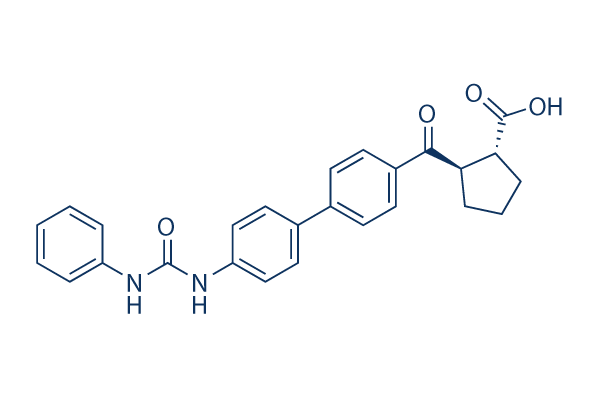
Chemical Structure
Molecular Weight: 428.48
Quality Control
Cell Culture, Treatment & Working Concentration
| Cell Lines | Assay Type | Concentration | Incubation Time | Formulation | Activity Description | PMID |
|---|---|---|---|---|---|---|
| Sf9 | Function assay | Inhibition of human recombinant DGAT1 expressed in Sf9 cells, IC50=0.007μM | 18183944 | |||
| Sf9 | Function assay | 60 mins | Inhibition of recombinant full length human DGAT1 expressed in Sf9 insect cells using 1,2-didecanoyl-sn-glycerol as substrate after 60 mins in presence of palmitoyl-1-14C coenzyme A by scintillation counting, IC50=0.0078μM | 28739155 | ||
| Sf9 | Function assay | 1 hr | Inhibition of human DGAT1 expressed in Sf9 cells assessed as formation of didecanoylglycerol product after 1 hr using 14C-decanoyl-CoA by beta scintillation counter, IC50=0.02μM | 21868220 | ||
| Sf9 | Function assay | Inhibition of mouse recombinant DGAT1 expressed in Sf9 cells, IC50=0.024μM | 18183944 | |||
| MA104 | Antiviral assay | 24 hrs | Antiviral activity against Rotavirus SA11 in MA104 cells assessed as inhibition of viral replication after 24 hrs by immunofluorescent assay and Western blotting analysis, ED50=23.2μM | 22365411 | ||
| Click to View More Cell Line Experimental Data | ||||||
Chemical Information, Storage & Stability
| Molecular Weight | 428.48 | Formula | C26H24N2O4 |
Storage (From the date of receipt) | |
|---|---|---|---|---|---|
| CAS No. | 959122-11-3 | Download SDF | Storage of Stock Solutions |
|
|
| Synonyms | DGAT-1 Inhibitor 4a | Smiles | C1CC(C(C1)C(=O)O)C(=O)C2=CC=C(C=C2)C3=CC=C(C=C3)NC(=O)NC4=CC=CC=C4 | ||
Solubility
|
In vitro |
DMSO
: 86 mg/mL
(200.7 mM)
Water : Insoluble Ethanol : Insoluble |
Molarity Calculator
|
In vivo |
|||||
In vivo Formulation Calculator (Clear solution)
Step 1: Enter information below (Recommended: An additional animal making an allowance for loss during the experiment)
Step 2: Enter the in vivo formulation (This is only the calculator, not formulation. Please contact us first if there is no in vivo formulation at the solubility Section.)
Calculation results:
Working concentration: mg/ml;
Method for preparing DMSO master liquid: mg drug pre-dissolved in μL DMSO ( Master liquid concentration mg/mL, Please contact us first if the concentration exceeds the DMSO solubility of the batch of drug. )
Method for preparing in vivo formulation: Take μL DMSO master liquid, next addμL PEG300, mix and clarify, next addμL Tween 80, mix and clarify, next add μL ddH2O, mix and clarify.
Method for preparing in vivo formulation: Take μL DMSO master liquid, next add μL Corn oil, mix and clarify.
Note: 1. Please make sure the liquid is clear before adding the next solvent.
2. Be sure to add the solvent(s) in order. You must ensure that the solution obtained, in the previous addition, is a clear solution before proceeding to add the next solvent. Physical methods such as vortex, ultrasound or hot water bath can be used to aid dissolving.
Mechanism of Action
| Features |
A potent, selective, and orally bioavailable DGAT-1 inhibitor.
|
|---|---|
| Targets/IC50/Ki |
human DGAT1
7 nM
mouse DGAT1
24 nM
|
| In vitro |
A 922500 inhibits the phylogenetic family members acyl coenzyme A cholesterol acyltransferase-1 and -2 with IC50 of 296 μM. A 922500 potently inhibits huDGAT-1 and mseDGAT-1. |
| Kinase Assay |
In vitro DGAT-1 activity inhibition assay
|
|
DGAT-1 activity is determined as follows: Assay buffer [20 mM HEPES (pH 7.5), 2 mM MgCl2, 0.04% BSA] containing 50
M of enzyme substrate (didecanoyl glycerol) and 7.5
M radiolabeled acyl-CoA substrate. [1- 14 C]decanoyl-CoA) is added to each well of a phospholipid FlashPlate. A small aliquot of membrane (1
g/well) is added to start the reaction, which is allowed to proceed for 60 minutes. The reaction is terminated upon the addition of an equal volume (100
L) of isopropanol. The plates are sealed, incubated overnight and counted the next morning on a TopCount Scintillation Plate Reader. DGAT-1 catalyzes the transfer of the radiolabeled decanoyl group onto the sn-3 position of didecanoyl glycerol. The resultant radiolabeled tridecanoyl glycerol (tricaprin) preferentially binds to the hydrophobic coating on the phospholipid FlashPlate. The proximity of the S15 radiolabeled product to the solid scintillant incorporated into the bottom of the FlashPlate induces fluor release from the scintillant, which is measured in the TopCount Plate Reader. Various concentrations (e.g. 0.0001
M, 0.001
M, 0.01
M, 0.1
M, 1.0
M, 10.0
M) of A 922500 are added to individual wells prior to the addition of membranes. The potency of DGAT-1 inhibition for the A 922500 is determined by calculating the IC50 values defined as the inhibitor concentration from the sigmoidal dose response curve at which the enzyme activity is inhibited.
|
|
| In vivo |
Zucker fatty rats and diet-induced dyslipidemic hamsters are dosed orally with A 922500 (0.03, 0.3, and 3 mg/kg) for 14 days. Serum triglycerides are significantly reduced by the 3 mg/kg dose of A 922500 in both the Zucker fatty rat (39%) and hyperlipidemic hamster (53%). These serum triglyceride changes are accompanied by significant reductions in free fatty acid levels by 32% in the Zucker fatty rat and 55% in the hyperlipidemic hamster. In addition, high-density lipoprotein-cholesterol is significantly increased (25%) in the Zucker fatty rat by A 922500 administered at 3 mg/kg. A 922500 confers weight loss and a reduction in liver triglycerides when dosed chronically in DIO mice and depletes serum triglycerides following a lipid challenge in a dose-dependent manner, thus, reproducing major phenotypical characteristics of DGAT-1(-/-) mice. A 922500 (0.03, 0.3 and 3 mg/kg, p.o.) dose-dependently attenuates the maximal postprandial rise in serum triglyceride concentrations. |
References |
|
Tech Support
Tel: +1-832-582-8158 Ext:3
If you have any other enquiries, please leave a message.

Products are for research use only. Not for human use. We do not sell to patients.
©Copyright 2013 Selleck Chemicals. All Rights Reserved.