
research use only
Asenapine maleate 5-HT Receptor antagonist
Cat.No.S1283
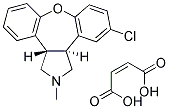
Chemical Structure
Molecular Weight: 401.84
Quality Control
| Related Targets | Adrenergic Receptor AChR COX Calcium Channel Histamine Receptor Dopamine Receptor GABA Receptor TRP Channel Cholinesterase (ChE) GluR |
|---|---|
| Other 5-HT Receptor Inhibitors | WAY-100635 Maleate Serotonin (5-HT) HCl Puerarin BRL-15572 Dihydrochloride SB269970 HCl Ketanserin RS-127445 Nuciferine Flopropione BRL-54443 |
Chemical Information, Storage & Stability
| Molecular Weight | 401.84 | Formula | C17H16ClNO.C4H4O4 |
Storage (From the date of receipt) | |
|---|---|---|---|---|---|
| CAS No. | 85650-56-2 | Download SDF | Storage of Stock Solutions |
|
|
| Synonyms | Org 5222 | Smiles | CN1CC2C(C1)C3=C(C=CC(=C3)Cl)OC4=CC=CC=C24.C(=CC(=O)O)C(=O)O | ||
Solubility
|
In vitro |
DMSO
: 80 mg/mL
(199.08 mM)
Water : Insoluble Ethanol : Insoluble |
Molarity Calculator
|
In vivo |
|||||
In vivo Formulation Calculator (Clear solution)
Step 1: Enter information below (Recommended: An additional animal making an allowance for loss during the experiment)
Step 2: Enter the in vivo formulation (This is only the calculator, not formulation. Please contact us first if there is no in vivo formulation at the solubility Section.)
Calculation results:
Working concentration: mg/ml;
Method for preparing DMSO master liquid: mg drug pre-dissolved in μL DMSO ( Master liquid concentration mg/mL, Please contact us first if the concentration exceeds the DMSO solubility of the batch of drug. )
Method for preparing in vivo formulation: Take μL DMSO master liquid, next addμL PEG300, mix and clarify, next addμL Tween 80, mix and clarify, next add μL ddH2O, mix and clarify.
Method for preparing in vivo formulation: Take μL DMSO master liquid, next add μL Corn oil, mix and clarify.
Note: 1. Please make sure the liquid is clear before adding the next solvent.
2. Be sure to add the solvent(s) in order. You must ensure that the solution obtained, in the previous addition, is a clear solution before proceeding to add the next solvent. Physical methods such as vortex, ultrasound or hot water bath can be used to aid dissolving.
Mechanism of Action
| Targets/IC50/Ki |
5-HT2C
10.46(pKi)
5-HT2A
10.15(pKi)
5-HT7
9.94(pKi)
5-HT2B
9.75(pKi)
5-HT6
9.6(pKi)
α2B-adrenergic receptor
9.49(pKi)
D3 receptor
9.38(pKi)
H1 receptor
9(pKi)
D4 receptor
8.95(pKi)
α1A-adrenergic receptor
8.93(pKi)
α2C-adrenergic receptor
8.91(pKi)
D2L Receptor
8.9(pKi)
α2A-adrenergic receptor
8.9(pKi)
D1 receptor
8.85(pKi)
5-HT5A
8.84(pKi)
D2S Receptor
8.84(pKi)
5-HT1A
8.6(pKi)
5-HT1B
8.4(pKi)
H2 receptor
8.21(pKi)
|
|---|---|
| In vitro |
Asenapine shows high affinity and a different rank order of binding affinities (pKi) for serotonin receptors (5-HT1A [8.6], 5-HT1B [8.4], 5-HT2A [10.2], 5-HT2B [9.8], 5-HT2C [10.5], 5-HT5 [8.8], 5-HT6 [9.6] and 5-HT7 [9.9]), adrenoceptors (alpha1 [8.9], alpha2A [8.9], alpha2B [9.5] and alpha2C [8.9]), dopamine receptors (D1 [8.9], D2 [8.9], D3 [9.4] and D4 [9.0]) and histamine receptors (H1 [9.0] and H2 [8.2]). Asenapine has a higher affinity for 5-HT2C, 5-HT2A, 5-HT2B, 5-HT7, 5-HT6, alpha2B and D3 receptors, suggesting stronger engagement of these targets at therapeutic doses. Asenapine behaves as a potent antagonist (pKB) at 5-HT1A (7.4), 5-HT1B (8.1), 5-HT2A (9.0), 5-HT2B (9.3), 5-HT2C (9.0), 5-HT6 (8.0), 5-HT7 (8.5), D2 (9.1), D3 (9.1), alpha2A (7.3), alpha2B (8.3), alpha2C (6.8) and H1 (8.4) receptors.
|
| In vivo |
Asenapine shows high affinity and a different rank order of binding affinities (pKi) for serotonin receptors (5-HT1A [8.6], 5-HT1B [8.4], 5-HT2A [10.2], 5-HT2B [9.8], 5-HT2C [10.5], 5-HT5 [8.8], 5-HT6 [9.6] and 5-HT7 [9.9]), adrenoceptors (alpha1 [8.9], alpha2A [8.9], alpha2B [9.5] and alpha2C [8.9]), dopamine receptors (D1 [8.9], D2 [8.9], D3 [9.4] and D4 [9.0]) and histamine receptors (H1 [9.0] and H2 [8.2]). Asenapine has a higher affinity for 5-HT2C, 5-HT2A, 5-HT2B, 5-HT7, 5-HT6, alpha2B and D3 receptors, suggesting stronger engagement of these targets at therapeutic doses. Asenapine behaves as a potent antagonist (pKB) at 5-HT1A (7.4), 5-HT1B (8.1), 5-HT2A (9.0), 5-HT2B (9.3), 5-HT2C (9.0), 5-HT6 (8.0), 5-HT7 (8.5), D2 (9.1), D3 (9.1), alpha2A (7.3), alpha2B (8.3), alpha2C (6.8) and H1 (8.4) receptors.
|
References |
|
Clinical Trial Information
(data from https://clinicaltrials.gov, updated on 2024-05-22)
| NCT Number | Recruitment | Conditions | Sponsor/Collaborators | Start Date | Phases |
|---|---|---|---|---|---|
| NCT01968161 | Unknown status | Schizophrenia and Disorders With Psychotic Features|Disorders |
Centre de Recherche de l''Institut Universitaire en Santé Mentale de Québec |
October 2013 | Phase 4 |
| NCT01734278 | Completed | Manic Disorder |
Professor Saad Shakir|Merck Sharp & Dohme LLC|Drug Safety Research Unit Southampton UK |
October 2012 | -- |
| NCT00281320 | Completed | Psychosis |
Organon and Co |
February 2006 | Phase 3 |
Tech Support
Tel: +1-832-582-8158 Ext:3
If you have any other enquiries, please leave a message.

Products are for research use only. Not for human use. We do not sell to patients.
©Copyright 2013 Selleck Chemicals. All Rights Reserved.