
Mitochondrial Metabolism Inhibitors
| Cat.No. | Product Name | Information | Product Use Citations | Product Validations |
|---|---|---|---|---|
| S6036 | ER-000444793 | ER-000444793 is a potent inhibitor of mitochondrial permeability transition pore (mPTP) opening with IC50 of 2.8 μM. | ||
| S2592 | Emapunil (AC 5216) | Emapunil (AC-5216, 18 kiloDalton Translocator Protein, XBD173) is a novel mitochondrial benzodiazepine receptor/translocator protein (MBR/TSPO) ligand. This compound shows high affinity for MBRs prepared from rat whole brain with Ki of 0.297 nM and IC50 of 3.04 nM and 2.73 nM at rat glioma cells and human glioma cells, respectively. | ||
| E0032 | Olesoxime (TRO 19622) |
Olesoxime (TRO19622) is a novel, orally active and CNS-penetrant mitochondrial-targeted neuroprotective compound. |
||
| E1888New | NIM811 ((Melle-4)cyclosporin) | NIM811 ((Melle-4)cyclosporin; SDZ NIM811) is an orally administered dual inhibitor targeting mitochondrial permeability transition and cyclophilin, demonstrating strong in vitro antiviral activity against hepatitis C virus (HCV). | ||
| S3593 | Rhodamine 6G | Rhodamine 6G (R6G, Basic Red 1, Rhodamine 590) is a fluorescence tracer that binds to mitochondria, thus reducing the intact mitochondria number and inhibiting mitochondrial metabolic activity. | ||
| E1252 | MitoPQ | MitoPQ (MitoParaquat), a mitochondria-targeted redox cycler, enables the selective generation of superoxide within mitochondria and is a useful tool to investigate the many roles of mitochondrial superoxide in pathology and redox signaling in cells and in vivo. | ||
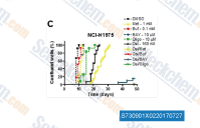
| S7309 | BAY 87-2243 | BAY 87-2243 is a potent and selective hypoxia-inducible factor-1 (HIF-1) inhibitor. This compound inhibits mitochondrial complex I activity, thus triggering a mitophagy-dependent ROS increase leading to necroptosis and Ferroptosis. It exerts antitumor activity. Phase 1. |
|
|
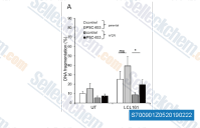
| S7009 | LCL161 | LCL-161, a small molecule second mitochondrial activator of caspase (SMAC) mimetic, potently binds to and inhibits multiple IAPs (i.e. XIAP, c-IAP). |
|
|
| S3296 | Hispidulin | Hispidulin (Dinatin), an active natural ingredient in a number of traditional Chinese medicinal herbs, exhibits inhibitory activity against the oncogenic protein kinase Pim-1 with IC50 of 2.71 μM. This compound induces apoptosis through mitochondrial dysfunction and inhibition of P13k/Akt signalling pathway in HepG2 cancer cells. It exerts anti-osteoporotic and bone resorption attenuating effects via activating the AMPK signalling pathway. |
|
|
| S8943 | VLX600 | VLX600 is a novel iron-chelating inhibitor of oxidative phosphorylation (OXPHOS), potentiates the effect of radiation in tumour spheroids in a synergistic manner. This compound shows enhanced cytotoxic activity under conditions of nutrient starvation. It induces autophagy and mitochondrial inhibition with antitumour activity. |
|
|
| S0411 | BAM 15 | BAM 15 is a novel mitochondrial protonophore uncoupler capable of protecting mammals from acute renal ischaemic-reperfusion injury and cold-induced microtubule damage. This compound is also a potent AMPK activator. It attenuates transportation-induced apoptosis in iPS-differentiated retinal tissue. |
|
|
| S3264 | Atractyloside potassium salt | Atractyloside potassium salt (ATR potassium salt), a toxic diterpenoid glycoside isolated from the fruits of Xanthium sibiricum (Cang'erzi), is a powerful and specific inhibitor of mitochondrial ADP/ATP carriers. This compound inhibits chloride channels from mitochondrial membranes of rat heart. | ||
| S0012 | E260 | E260 (Fer and FerT inhibitor E260) is a Fer kinase and FerT inhibitor that selectively evokes metabolic stress in cancer cells by imposing mitochondrial dysfunction and deformation, and onset of energy-consuming autophagy which decreases the cellular ATP level. | ||
| S9925 | Imeglimin (EMD 387008) Hydrochloride |
Imeglimin (EMD 387008, IMEG, PXL 008, RVT-1501) Hydrochloride is a new class of oral glucose-lowering agents. Imeglimin normalises glucose tolerance and insulin sensitivity by preserving mitochondrial function from oxidative stress and favouring lipid oxidation in liver of HFHSD mice. |

Products are for research use only. Not for human use. We do not sell to patients.
©Copyright 2013 Selleck Chemicals. All Rights Reserved.