
FXR Agonists
| Cat.No. | Product Name | Information | Product Use Citations | Product Validations |
|---|---|---|---|---|
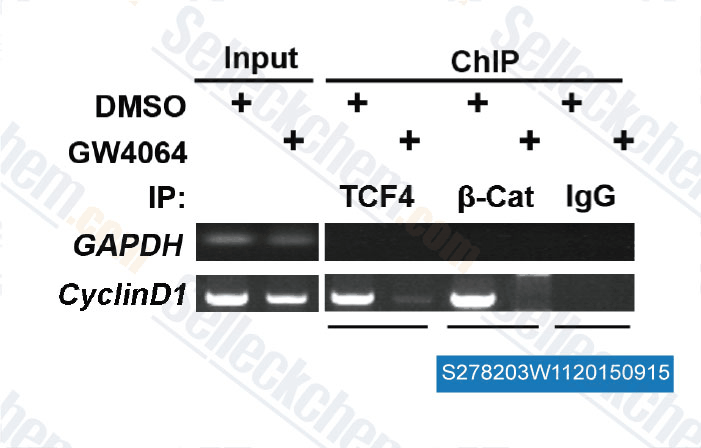
| S2782 | GW4064 | GW4064 is an agonist of farnesoid X receptor (FXR) with EC50 of 65 nM in CV1 cell line and displays no activity at other nuclear receptors at concentrations up to 1 μM. This compound stimulates Autophagy in MCF-7 cells. |
|
|
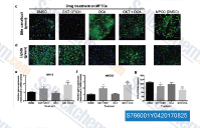
| S7660 | Obeticholic Acid (INT-747) | Obeticholic Acid (INT-747) is a potent and selective farnesoid X receptor (FXR) agonist with EC50 of 99 nM, and it inhibits autophagy. This compound is in Phase 3. |
|
|
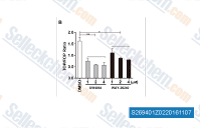
| S2694 | Turofexorate Isopropyl (XL335) | Turofexorate Isopropyl (XL335, Fxr 450) is a potent, selective FXR agonist with EC50 of 4 nM, highly selective versus other nuclear receptors, such as LXR, PPAR, ER and etc. Phase 1. |
|
|
| S1843 | Chenodeoxycholic Acid | Chenodeoxycholic Acid (Chenodiol, Chenodesoxycholic acid, Chenocholic acid,CDCA) is a naturally occurring human bile acid, and inhibits production of cholesterol in the liver and absorption in the intestines. This compound is a hydrophobic primary bile acid that activates nuclear receptors (FXR) involved in cholesterol Metabolism. |
|
|
| S4003 | Lithocholic acid | Lithocholic acid is a toxic secondary bile acid, causes intrahepatic cholestasis, has tumour-promoting activity, its toxic effect can be protected after it activates the vitamin D receptor, PXR and FXR. |
|
|
| S6413 | fexaramine | fexaramine is a potent, selective farnesoid X receptor (FXR) agonist with an EC50 of 25 nM and it displays no activity at hRXRα, hPPARα, hPPARγ, hPPARδ, mPXR, hPXR, hLXRα, hTRβ, hRARβ, mCAR, mERRγ and hVDR receptors. |
|
|
| S0033 | BAR502 | BAR502 (Compound 30) is a dual FXR and GPBAR1 agonist with IC50 values of 2 μM and 0.4 μM, respectively. | ||
| S0037 | Nidufexor (LMB-763) | Nidufexor (LMB-763) is an agonist of farnesoid X receptor (FXR). | ||
| S8733 | Tropifexor (LJN452) | Tropifexor (LJN452) is a novel and highly potent agonist of FXR with EC50 of 0.2 nM in HTRF assay. This compound shows no significant off-target activity against a broad panel of enzyme, ion channel, nuclear receptor, and GPCR (>10000-fold selectivity for FXR). | ||
| S0874 | Vonafexor (EYP001) | Vonafexor (EYP001, PLX007) is a novel non-bile acid, selective, second generation farnesoid X receptor (FXR) agonist. | ||
| S6547 | Cilofexor (GS-9674) | Cilofexor (GS-9674) is a potent, selective oral agonist of farnesoid X receptor (FXR) with an EC50 of 43 nM. It has demonstrated anti-inflammatory, antifibrotic effects, and reduced portal pressure in preclinical liver fibrosis models, showing potential therapeutic benefit for primary sclerosing cholangitis (PSC) and nonalcoholic steatohepatitis (NASH) research. | ||
| E5874New | INT-767 | INT-767 is a dual agonist of farnesoid X receptor (FXR)/TGR5 with an EC50 of 0.033 μM and 0.67 μM, respectively. It significantly improves serum liver enzymes, hepatic inflammation, and biliary fibrosis, while inducing bile flow and biliary HCO₃⁻ output, making it a promising tool for chronic cholangiopathy research. | ||
| S0403 | LY2562175 | LY2562175 is a potent and selective agonist of FXR. This compound promotes transcriptional activation of human FXR in a cell-based cotransfection assay with EC50 of 193 nM. | ||
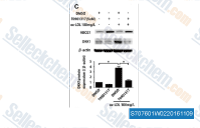
| S7076 | T0901317 | T0901317 is a potent and selective agonist for both LXR and FXR, with EC50 of 20nM for LXR and 5 M for FXR, respectively. This compound is a dual inverse agonist of ROR and ROR with Ki of 132 nM and 51 nM, respectively. It significantly suppresses cell proliferation and induces apoptosis. |
|
|

Products are for research use only. Not for human use. We do not sell to patients.
©Copyright 2013 Selleck Chemicals. All Rights Reserved.