
research use only
Y-27632 Dihydrochloride ROCK inhibitor
Cat.No.S1049
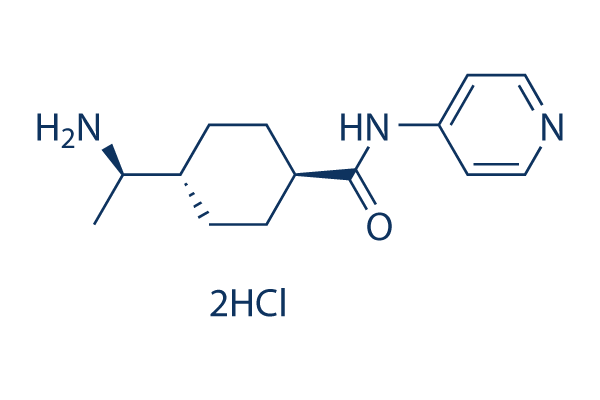
Chemical Structure
Molecular Weight: 320.26
Quality Control
Products Often Used Together with Y-27632 Dihydrochloride
Cell Culture, Treatment & Working Concentration
| Cell Lines | Assay Type | Concentration | Incubation Time | Formulation | Activity Description | PMID |
|---|---|---|---|---|---|---|
| Salivary gland stem cells | Function Assay | 10 µM | 7 d | Reduces SGSC senescence | 25804560 | |
| HT22 | Cytotoxic Assay | 10 µM | 13 h | Protects against glutamate-induced neuronal death | 22810835 | |
| Swiss3T3 | Colony-forming Assay | 10 µM | 13 d | Increases prostate cell colony-forming activity | 21464902 | |
| TSGH 8301 | Migration Assay | 20 µM | 1 h | Increases cell migration | 19896475 | |
| Cynomolgus monkey embryonic stem cells | Cytotoxic Assay | 20 µM | 24 h | Promotes cyES cell survival | 18940855 | |
| PC 12 | Function Assay | 10 μM | 24 h | Attenuates catecholamine biosynthesis | 16219424 | |
| C2C12 | Function Assay | 10 μM | 6 h | Prevents the serine phosphorylation of IRS-1 induced by insulin and/or TNF-α | 16267124 | |
| Pancreatic acinar cells | Function Assay | 10 μM | 70 min | Potentiates CCK-stimulated pancreatic enzyme secretion | 12745080 | |
| Rat hepatic stellate cells | Function Assay | 30 μM | 48 h | Diminishes the phosphorylation of Erk2, and decreases new DNA synthesis | 10845663 | |
| LNCaP | Growth Inhibition Assay | 25 μM | 17 h | Does not inhibit cell growth | 10720471 | |
| PC3 | Growth Inhibition Assay | 25 μM | 17 h | Does not inhibit cell growth | 10720471 | |
| PC3 | Migration Assay | 25 μM | 1 h | Inhibits the BMFB-CM and the EGF-stimulated migration | 10720471 | |
| PC3 | Function Assay | 25 μM | 1 h | Induces morphological changes | 10720471 | |
| Rat Vascular Smooth Muscle Cells | Function Assay | 10 μM | 2 h | Inhibits angiotensin II-induced hypertrophy | 10642317 | |
| Stellate Cell | Function Assay | 25 μM | 15 min | Inhibits formation of F-actin stress fibers and phosphorylation of myosin light chain | 10600496 | |
| Neonatal rat ventricular myocytes | Function Assay | 10 μM | 48 h | Inhibits ET-1-induced increases in protein synthesis, cell size and myofibrillar organization | 10386613 | |
| LS174T | Growth Inhibition Assay | 10 μM | 18 d | Moderately inhibits cell growth | 10021386 | |
| HCT116 | Growth Inhibition Assay | 10 μM | 18 d | Strongly inhibits cell growth | 10021386 | |
| HCT15 | Growth Inhibition Assay | 10 μM | 18 d | Does not inhibit cell growth | 10021386 | |
| SW620 | Growth Inhibition Assay | 10 μM | 18 d | Does not inhibit cell growth | 10021386 | |
| Src-2 | Growth Inhibition Assay | 10 μM | 18 d | Does not inhibit cell growth | 10021386 | |
| Src-1 | Growth Inhibition Assay | 10 μM | 18 d | Does not inhibit cell growth | 10021386 | |
| NIH3T3 | Growth Inhibition Assay | 10 μM | 18 d | Does not inhibit cell growth | 10021386 | |
| Src-4 | Growth Inhibition Assay | 10 μM | 18 d | Does not inhibit cell growth | 10021386 | |
| Src-1 | Growth Inhibition Assay | 10 μM | 18 d | Does not inhibit cell growth | 10021386 | |
| Ras-4 | Growth Inhibition Assay | 10 μM | 18 d | Strongly inhibits cell growth | 10021386 | |
| Ras-2 | Growth Inhibition Assay | 10 μM | 18 d | Strongly inhibits cell growth | 10021386 | |
| mNET1-e | Growth Inhibition Assay | 10 μM | 18 d | Strongly inhibits cell growth | 10021386 | |
| mNET1-d | Growth Inhibition Assay | 10 μM | 18 d | Strongly inhibits cell growth | 10021386 | |
| Dbl-e | Growth Inhibition Assay | 10 μM | 18 d | Moderately inhibits cell growth | 10021386 | |
| Dbl-d | Growth Inhibition Assay | 10 μM | 18 d | Strongly inhibits cell growth | 10021386 | |
| NIH3T3 | Growth Inhibition Assay | 10 μM | 18 d | Does not inhibit cell growth | 10021386 | |
| Mesothelial cells from rat mesentery | Invasive Assay | 30 μM | 20 h | Blocks invasive activity | 9930872 | |
| CCL39 | Function Assay | 30 μM | 30 min | Completely abolishes activation of Na-H exchanger NHE1 by integrins | 9693382 | |
| HeLa | Function Assay | 10 μM | 30 min | Inhibits the formation of stress fibers and the assembly of vinculin-containing focal adhesions | 9668072 | |
| N1E-115 | Function Assay | 10 μM | 2 h | DMSO | Inhibits the assembly of microtubules and intermediate filaments to form extended processes | 9647654 |
| Swiss 3T3 cells | Function Assay | 10 μM | 2 h | DMSO | Inhibits the assembly of microtubules and intermediate filaments to form extended processes | 9647654 |
| Click to View More Cell Line Experimental Data | ||||||
Chemical Information, Storage & Stability
| Molecular Weight | 320.26 | Formula | C14H21N3O.2HCl |
Storage (From the date of receipt) | |
|---|---|---|---|---|---|
| CAS No. | 129830-38-2 | Download SDF | Storage of Stock Solutions |
|
|
| Synonyms | N/A | Smiles | CC(C1CCC(CC1)C(=O)NC2=CC=NC=C2)N.Cl.Cl | ||
Solubility
|
In vitro |
DMSO
: 64 mg/mL
(199.83 mM)
Water : 64 mg/mL Ethanol : 4 mg/mL |
Molarity Calculator
|
In vivo |
|||||
In vivo Formulation Calculator (Clear solution)
Step 1: Enter information below (Recommended: An additional animal making an allowance for loss during the experiment)
Step 2: Enter the in vivo formulation (This is only the calculator, not formulation. Please contact us first if there is no in vivo formulation at the solubility Section.)
Calculation results:
Working concentration: mg/ml;
Method for preparing DMSO master liquid: mg drug pre-dissolved in μL DMSO ( Master liquid concentration mg/mL, Please contact us first if the concentration exceeds the DMSO solubility of the batch of drug. )
Method for preparing in vivo formulation: Take μL DMSO master liquid, next addμL PEG300, mix and clarify, next addμL Tween 80, mix and clarify, next add μL ddH2O, mix and clarify.
Method for preparing in vivo formulation: Take μL DMSO master liquid, next add μL Corn oil, mix and clarify.
Note: 1. Please make sure the liquid is clear before adding the next solvent.
2. Be sure to add the solvent(s) in order. You must ensure that the solution obtained, in the previous addition, is a clear solution before proceeding to add the next solvent. Physical methods such as vortex, ultrasound or hot water bath can be used to aid dissolving.
Mechanism of Action
| Targets/IC50/Ki |
ROCK1 (p160ROCK)
(Cell-free assay) 140 nM(Ki)
ROCK2
(Cell-free assay) 300 nM(Ki)
|
|---|---|
| In vitro |
Y-27632 2HCl inhibits ROCK-II while displaying little activity against PKC, cAMP-dependent protein kinase and myosin light-chain kinase (MLCK) with Ki of 26 μM, 25 μM and > 250 μM, respectively, as well as PKA activated by another Rho-family GTPase member, Cdc42. This compound inhibits smooth-muscle contraction induces by various agonists including phenylephrine, histamine, acetylcholine, serotonin, endothelin, and thromboxane with IC50 of 0.3-1 μM, by selectively inhibiting Ca2+ sensitization. It suppresses Rho-induced, p160ROCK-mediated formation of stress fibres in cultured cells. This chemical treatment blocks both Rho-mediated activation of actomyosin and LPA-stimulated invasive activity of MM1 cells in a concentration-dependent manner. This compound treatment is not only sufficient to initiate formation of exuberant axonal processes but also facilitates axonal maturation during the very early stages of axonogenesis, while largely sparing axon elongation. In human embryonic stem (hES) cells, this chemical treatment at 10 μM markedly diminishes dissociation-induced apoptosis even in serum-free suspension (SFEB) culture, increases cloning efficiency (from ~1% to ~27%), facilitates subcloning after gene transfer, and enables SFEB-cultured hES cells to survive and differentiate into Bf1+ cortical and basal telencephalic progenitors. |
| Kinase Assay |
Phosphorylation reactions
|
|
The p160ROCK is expressed in COS cells as tagged full-length proteins, and immunoprecipitated by the use of anti-tag antibodies. The p160ROCK (30 ng) is incubated with 40 μM [γ-32P]ATP (3.3 Ci/mmol) and with 3 μg of either histone (HF2A), dephosphorylated casein or MBP in the presence of various concentrations of this compound at 30 °C in a total volume of 31 μL. A 7 μL aliquot is taken at 0, 5, 10, and 20 minutes, mixed with an equal volume of 2 × Laemmli sample buffer, and applied to SDS-PAGE. The gel is stained with Commassie Blue, dried and subjected to analysis by a Bioimage Analyzer BAS2000. The concentration of this chemical required to inhibit p160ROCK activity by 50% (IC50 value) is obtained. Ki value is calculated according to the equation, Ki = IC50/(1 + S/Km), where S and Km represent concentrations of and Km value for ATP.
|
|
| In vivo |
Oral administration of Y-27632 2HCl at 30 mg/kg significantly decreases the blood pressure in a dose-dependent manner in spontaneous hypertensive rats, renal hypertensive rats, as well as deoxycorticosterone acetate (DOCA)-salt hypertensive rats. When this compound is continuously administered at a rate of 0.55 μL per hour by implanted pumps for 11 days tumor cell invasion (MM1 cells expressing Val14-RhoA in rats) is significantly delayed. By inhibiting ROCK, this chemical treatment attenuates hypoxia-induced angiogenesis and vascular remodeling in the pulmonary circulation. Pretreatment with this compound has a protective effect against tumor formation in albino mice with Ehrlich ascites carcinoma. |
References |
|
Applications
| Methods | Biomarkers | Images | PMID |
|---|---|---|---|
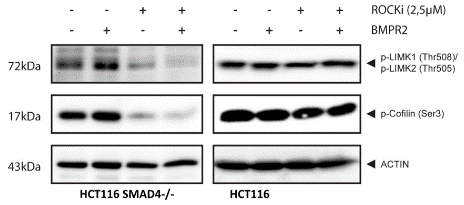
| Western Blot | p-LIMK1(Thr508) p-LIMK2(Thr505) p-Cofilin(Ser3) CDK2 KRT7 ROCK2 E-cadherin p-MLC2(Ser19) |
|
24704720 |
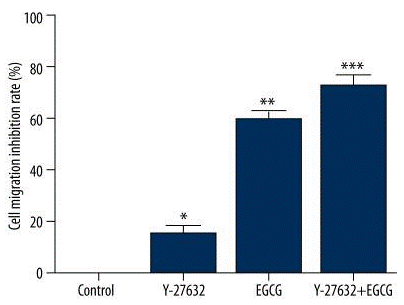
| Transwell migration assay | cell migration inhibition |
|
27694793 |
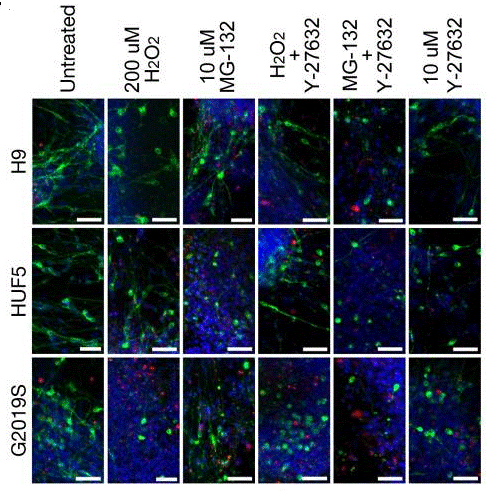
| Immunofluorescence | Neurotoxicity Assay E-cadherin beta-catenin Phalloidin |
|
21362567 |
| Growth inhibition assay | cell proliferation |
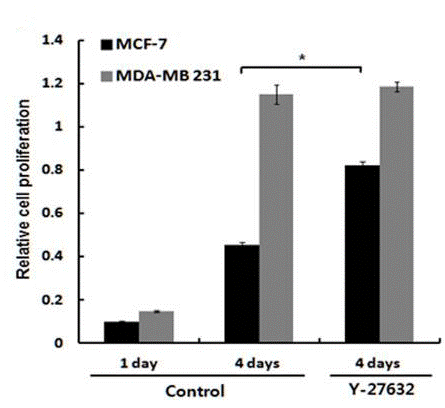
|
24523903 |
| ELISA | caspase-9 |
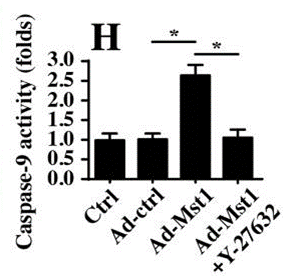
|
30320378 |
Tech Support
Tel: +1-832-582-8158 Ext:3
If you have any other enquiries, please leave a message.
Frequently Asked Questions
Question 1:
Is there any data about the Amax (maximum attraction luminosity) and extinction coefficient of it?
Answer:
The wavelength used to test its HPLC is 260nm, while the extinction coefficient is unknown.
Question 2:
Could it be used in cell culture? Do you have any reference for this application?
Answer:
Yes. It can be used in cell culture certainly. Here is the reference website: http://molpharm.aspetjournals.org/content/57/5/976.full.

Products are for research use only. Not for human use. We do not sell to patients.
©Copyright 2013 Selleck Chemicals. All Rights Reserved.