
research use only
EPZ-6438 (Tazemetostat) EZH2 inhibitor
Cat.No.S7128
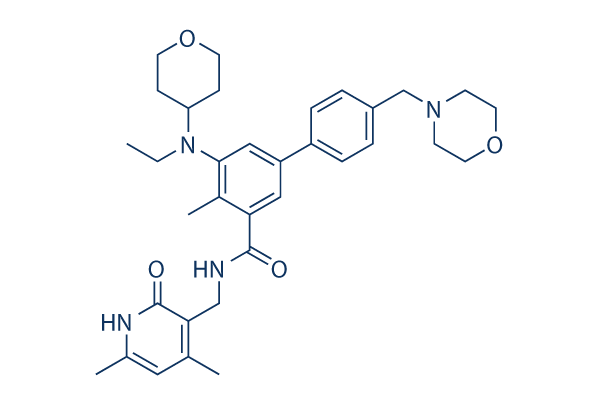
Chemical Structure
Molecular Weight: 572.74
Quality Control
Products Often Used Together with EPZ-6438 (Tazemetostat)
| Related Targets | HDAC JAK BET Histone Methyltransferase PKC PARP HIF PRMT AMPK Histone Acetyltransferase |
|---|---|
| Other EZH2 Inhibitors | PF-06821497 GSK126 Tulmimetostat (CPI-0209) GSK343 EBI-2511 EZH2/HSP90-IN-29 SHR2554 |
Cell Culture, Treatment & Working Concentration
| Cell Lines | Assay Type | Concentration | Incubation Time | Formulation | Activity Description | PMID |
|---|---|---|---|---|---|---|
| human HeLa cells | Function assay | 72 h | Inhibition of EZH2 in human HeLa cells assessed as reduction in H3K27me3 levels incubated for 72 hrs by ELISA method, IC50=0.02 μM. | 26189078 | ||
| Sf9 | Function assay | 2 h | Inhibition of human N-terminal His-tagged EZH2/flag-tagged EED/SUZ12/AEBP2/RBAP48 A677G mutant (2 to end residues) expressed in baculovirus infected Sf9 insect cells using histone H3 (1 to 50 residues)-GGK as substrate after 2 hrs in presence of SAM by fl, IC50 = 0.004 μM. | 29456795 | ||
| KARPAS422 | Antiproliferative activity assay | 3 to 4 days up to 14 days | Antiproliferative activity against human KARPAS422 cells harboring monoallelic Y641N EZH2 mutation assessed as reduction in cell viability measured every 3 to 4 days up to 14 days by Beckman Coulter-based method, IC50 = 0.012 μM. | 28092155 | ||
| Pfeiffer | Cytotoxicity assay | 5 days | Cytotoxicity against human Pfeiffer cells assessed as decrease in cell viability after 5 days by CellTiter-Glo reagent based luminescence assay, IC50 = 0.038 μM. | 29456795 | ||
| G401 | Function assay | 48 h | Inhibition of EED in human G401 cells assessed as reduction in global H3K27me3 level after 48 hrs by ELISA, IC50 = 0.04 μM. | 28092155 | ||
| G401 | Function assay | 4 h | Inhibition of methyltransferase activity of EZH2 in human G401 cells assessed as H3K27 trimethylation after 4 hrs by ELISA, EC50 = 0.2 μM. | 26769278 | ||
| Pfeiffer | Antitumor assay | 100 mg/kg | 20 days | Antitumor activity against human Pfeiffer cells xenografted in athymic nude mouse assessed as tumor growth inhibition at 100 mg/kg, po qd administered for 20 days measured twice per week | 29456795 | |
| Click to View More Cell Line Experimental Data | ||||||
Chemical Information, Storage & Stability
| Molecular Weight | 572.74 | Formula | C34H44N4O4 |
Storage (From the date of receipt) | |
|---|---|---|---|---|---|
| CAS No. | 1403254-99-8 | Download SDF | Storage of Stock Solutions |
|
|
| Synonyms | E7438 | Smiles | CCN(C1CCOCC1)C2=CC(=CC(=C2C)C(=O)NCC3=C(C=C(NC3=O)C)C)C4=CC=C(C=C4)CN5CCOCC5 | ||
Solubility
|
In vitro |
DMSO
: 100 mg/mL
(174.59 mM)
Water : Insoluble Ethanol : Insoluble |
Molarity Calculator
|
In vivo |
|||||
In vivo Formulation Calculator (Clear solution)
Step 1: Enter information below (Recommended: An additional animal making an allowance for loss during the experiment)
Step 2: Enter the in vivo formulation (This is only the calculator, not formulation. Please contact us first if there is no in vivo formulation at the solubility Section.)
Calculation results:
Working concentration: mg/ml;
Method for preparing DMSO master liquid: mg drug pre-dissolved in μL DMSO ( Master liquid concentration mg/mL, Please contact us first if the concentration exceeds the DMSO solubility of the batch of drug. )
Method for preparing in vivo formulation: Take μL DMSO master liquid, next addμL PEG300, mix and clarify, next addμL Tween 80, mix and clarify, next add μL ddH2O, mix and clarify.
Method for preparing in vivo formulation: Take μL DMSO master liquid, next add μL Corn oil, mix and clarify.
Note: 1. Please make sure the liquid is clear before adding the next solvent.
2. Be sure to add the solvent(s) in order. You must ensure that the solution obtained, in the previous addition, is a clear solution before proceeding to add the next solvent. Physical methods such as vortex, ultrasound or hot water bath can be used to aid dissolving.
Mechanism of Action
| Features |
Orally bioavailable EZH2-selective inhibitor for both wild-type and mutant. Currently being tested in Phase II clinical trials for treatment of Diffuse Large B Cell Lymphoma.
|
|---|---|
| Targets/IC50/Ki |
EZH2
(Cell-free assay) 2.5 nM(Ki)
|
| In vitro |
Tazemetostat (EPZ-6438) concentration-dependently reduces global H3K27Me3 levels in wild-type or SMARCB1 mutant cells, and induces strong antiproliferative effects with IC50 ranging from 32 nM to 1000 nM in SMARCB1-deleted MRT cell lines. It induces gene expression of neuronal differentiation and cell cycle inhibition, while inhibtis expression of Hedgehog pathway genes, MYC and EZH2. The antiproliferative effect of this compound is enhanced by either NSC-9900 or Hexadecadrol in several EZH2 mutant lymphoma cell lines. |
| Kinase Assay |
Biochemical Methods
|
|
Tazemetostat (EPZ-6438) is incubated for 30 min with 40 μL per well of 5 nM PRC2 (final assay concentration in 50 μL is 4 nM) in 1X assay buffer (20 mM Bicine [pH 7.6], 0.002% Tween-20, 0.005% Bovine Skin Gelatin and 0.5 mM DTT). 10 μL per well of substrate mix comprising assay buffer 3 H-SAM, unlabeled SAM, and peptide representing histone H3 residues 21-44 containing C-terminal biotin (appended to a C-terminal amide-capped lysine) are added to initiate the reaction (both substrates are present in the final reaction mixture at their respective Km values, an assay format referred to as ‘‘balanced conditions’’. The final concentrations of substrates and methylation state of the substrate peptide are indicated for each enzyme Reactions are incubated for 90 min at room temperature and quenched with 10 μL per well of 600 μM unlabeled SAM, Then transferred to a 384-well flashplate and washed after 30 min.
|
|
| In vivo |
In SCID mice bearing s.c. G401 xenografts, Tazemetostat (EPZ-6438) induces tumour stasis during the administration period and produces a significant tumour growth delay with minimal effect on body weight. |
References |
|
Applications
| Methods | Biomarkers | Images | PMID |
|---|---|---|---|
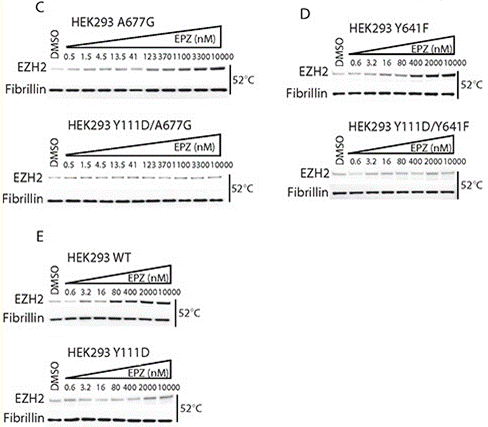
| Western blot | EZH2 H3K27me3 |
|
26360609 |
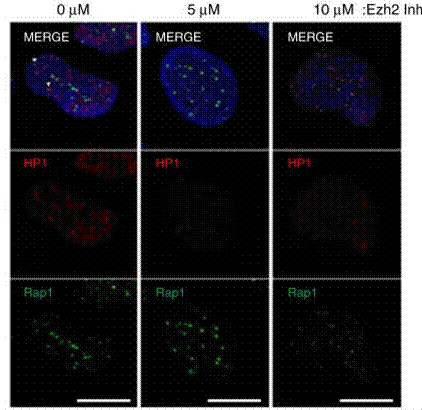
| Immunofluorescence | HP1/Rap1 |
|
29670078 |
Tech Support
Tel: +1-832-582-8158 Ext:3
If you have any other enquiries, please leave a message.
Frequently Asked Questions
Question 1:
Could you please help test the formulation of it for in vivo studies?
Answer:
We've tried some vehicles for it, and found this compound can be dissolved in 2% DMSO+30% PEG 300+5% Tween+ddH2O at 5 mg/ml as a clear solution. Dissolved in 5% DMSO+0.5% CMC Na at 15 mg/ml, it is a suspension for oral gavage.

Products are for research use only. Not for human use. We do not sell to patients.
©Copyright 2013 Selleck Chemicals. All Rights Reserved.