
research use only
BMN-673 (Talazoparib) PARP inhibitor
Cat.No.S7048
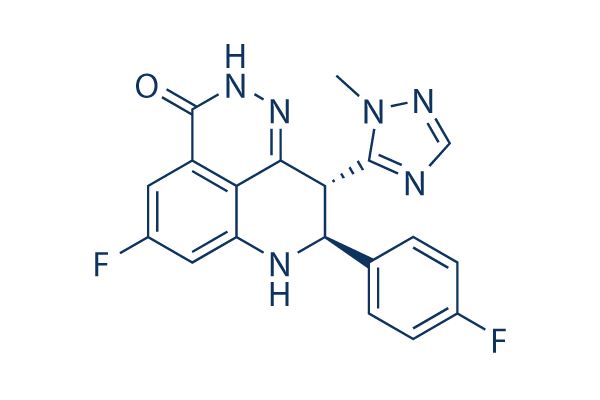
Chemical Structure
Molecular Weight: 380.35
Quality Control
| Related Targets | HDAC ATM/ATR DNA-PK WRN DNA/RNA Synthesis Topoisomerase PPAR Sirtuin Casein Kinase eIF |
|---|---|
| Other PARP Inhibitors | XAV-939 AZD5305 (Saruparib) Veliparib (ABT-888) PJ34 HCl AG-14361 Iniparib (BSI-201) G007-LK Pamiparib UPF 1069 A-966492 |
Cell Culture, Treatment & Working Concentration
| Cell Lines | Assay Type | Concentration | Incubation Time | Formulation | Activity Description | PMID |
|---|---|---|---|---|---|---|
| BR5FVB1-Akt | Growth Inhibition Assay | 0.1-100 nM | 24/48/72 h | inhibits cell proliferation dose dependently | 26047697 | |
| BR5FVB1-Akt | Apoptosis Assay | 0.1-100 nM | 72 h | induces apoptosis | 26047697 | |
| Capan-1 | Growth Inhibition Assay | IC50=16.0 ± 5.4 µM | 25864590 | |||
| MIA PaCa-2 | Growth Inhibition Assay | IC50=58.23 ± 8.1 µM | 25864590 | |||
| RD | Growth Inhibition Assay | IC50=8.7 nM | 25263539 | |||
| Rh41 | Growth Inhibition Assay | IC50=8.1 nM | 25263539 | |||
| Rh18 | Growth Inhibition Assay | IC50=4.9 nM | 25263539 | |||
| Rh30 | Growth Inhibition Assay | IC50=31.1 nM | 25263539 | |||
| BT-12 | Growth Inhibition Assay | IC50> 1,000 nM | 25263539 | |||
| CHLA-266 | Growth Inhibition Assay | IC50> 1,000 nM | 25263539 | |||
| TC-71 | Growth Inhibition Assay | IC50=3.7 nM | 25263539 | |||
| CHLA-9 | Growth Inhibition Assay | IC50=8.2 nM | 25263539 | |||
| CHLA-10 | Growth Inhibition Assay | IC50=67.8 nM | 25263539 | |||
| CHLA-258 | Growth Inhibition Assay | IC50=4.6 nM | 25263539 | |||
| SJ-GBM2 | Growth Inhibition Assay | IC50=16.2 nM | 25263539 | |||
| NB-1643 | Growth Inhibition Assay | IC50=18.4 nM | 25263539 | |||
| NB-EBc1 | Growth Inhibition Assay | IC50=25.8 nM | 25263539 | |||
| CHLA-90 | Growth Inhibition Assay | IC50> 1,000 nM | 25263539 | |||
| CHLA-136 | Growth Inhibition Assay | IC50=14.2 nM | 25263539 | |||
| NALM-6 | Growth Inhibition Assay | IC50=49 nM | 25263539 | |||
| COG-LL-317 | Growth Inhibition Assay | IC50=9.4 nM | 25263539 | |||
| RS4;11 | Growth Inhibition Assay | IC50=52.6 nM | 25263539 | |||
| MOLT-4 | Growth Inhibition Assay | IC50=16.6 nM | 25263539 | |||
| CCRF-CEM | Growth Inhibition Assay | IC50=697.3 nM | 25263539 | |||
| Kasumi-1 | Growth Inhibition Assay | IC50=786.2 nM | 25263539 | |||
| Karpas-299 | Growth Inhibition Assay | IC50=75.7 nM | 25263539 | |||
| Ramos-RA1 | Growth Inhibition Assay | IC50=68.3 nM | 25263539 | |||
| DT40 | Growth Inhibition Assay | IC50=4 nM | 24356813 | |||
| DU145 | Growth Inhibition Assay | IC50=11 nM | 24356813 | |||
| H209 | Growth Inhibition Assay | IC50=1.7 nM | 24077350 | |||
| H1048 | Growth Inhibition Assay | IC50=2.2 nM | 24077350 | |||
| H524 | Growth Inhibition Assay | IC50=3.1 nM | 24077350 | |||
| H1930 | Growth Inhibition Assay | IC50=4.1 nM | 24077350 | |||
| H69 | Growth Inhibition Assay | IC50=5.2 nM | 24077350 | |||
| H2081 | Growth Inhibition Assay | IC50=6.3 nM | 24077350 | |||
| H2107 | Growth Inhibition Assay | IC50=7.3 nM | 24077350 | |||
| H1092 | Growth Inhibition Assay | IC50=8.9 nM | 24077350 | |||
| DMS-79 | Growth Inhibition Assay | IC50=9.3 nM | 24077350 | |||
| H446 | Growth Inhibition Assay | IC50=13 nM | 24077350 | |||
| COR-L279 | Growth Inhibition Assay | IC50=15 nM | 24077350 | |||
| LoVo | Function assay | 30 mins | EC50 = 0.0025 μM | 25761096 | ||
| MX1 | Cytotoxicity assay | EC50 = 0.0003 μM | 26652717 | |||
| LoVo | Function assay | 30 mins | EC50 = 0.00251 μM | 26652717 | ||
| LoVo | Cytotoxicity assay | 0.4 uM | 5 days | GI50 = 0.004 μM | 26652717 | |
| Capan1 | Cytotoxicity assay | EC50 = 0.005 μM | 26652717 | |||
| MRC5 | Cytotoxicity assay | EC50 = 0.31 μM | 26652717 | |||
| MX1 | Function assay | 1 mg/kg | 2 ,8 and 24 hrs | Decrease in PAR level in athymic nu/nu mouse xenografted with human MX1 cells at 1 mg/kg, po administered as single dose measured after 2 ,8 and 24 hrs by ELISA | 26652717 | |
| MX1 | Antitumor assay | 0.33 mg/kg | 28 days | Antitumor activity against BRCA1 deficient human MX1 cells xenografted in athymic nu/nu mouse at 0.33 mg/kg, po qd administered for 28 days | 26652717 | |
| MX1 | Antitumor assay | 0.165 mg/kg | 28 days | Antitumor activity against BRCA1 deficient human MX1 cells xenografted in athymic nu/nu mouse assessed as tumor growth inhibition at 0.165 mg/kg, po administered twice a day for 28 days | 26652717 | |
| MX1 | Function assay | 0.33 mg/kg | Potentiation of carboplatin-induced tumor growth inhibition of BRCA1 deficient human MX1 cells xenografted in athymic nu/nu mouse at 0.33 mg/kg po and animals were treated with carboplatin at 35 mg/kg, ip on day 1 | 26652717 | ||
| MDA-MB-436 | Antiproliferative assay | 7 days | IC50 = 0.0007 μM | 28692916 | ||
| Capan1 | Antiproliferative assay | 7 days | IC50 = 0.0018 μM | 28692916 | ||
| VC8 | Cytotoxicity assay | 3 days | IC50 = 0.0042 μM | 28692916 | ||
| V79 | Cytotoxicity assay | 3 days | IC50 = 5.0114 μM | 28692916 | ||
| Capan1 | Function assay | 0.1 uM | 4 hrs | Inhibition of PARP1 in BRCA2 deficient human Capan1 cells assessed as increase in PARP1-DNA trapping at 0.1 uM after 4 hrs by Western blot analysis | 28692916 | |
| MDA-MB-436 | Function assay | 1 uM | 4 hrs | Inhibition of PARP1 in BRCA1 deficient human MDA-MB-436 cells assessed as increase in PARP1-DNA trapping at 1 uM after 4 hrs by Western blot analysis | 28692916 | |
| Click to View More Cell Line Experimental Data | ||||||
Chemical Information, Storage & Stability
| Molecular Weight | 380.35 | Formula |
C19H14F2N6O
|
Storage (From the date of receipt) | |
|---|---|---|---|---|---|
| CAS No. | 1207456-01-6 | -- | Storage of Stock Solutions |
|
|
| Synonyms | LT-673 | Smiles | CN1C(=NC=N1)C2C(NC3=CC(=CC4=C3C2=NNC4=O)F)C5=CC=C(C=C5)F | ||
Solubility
|
In vitro |
DMSO
: 19 mg/mL
(49.95 mM)
Water : Insoluble Ethanol : Insoluble |
Molarity Calculator
|
In vivo |
|||||
In vivo Formulation Calculator (Clear solution)
Step 1: Enter information below (Recommended: An additional animal making an allowance for loss during the experiment)
Step 2: Enter the in vivo formulation (This is only the calculator, not formulation. Please contact us first if there is no in vivo formulation at the solubility Section.)
Calculation results:
Working concentration: mg/ml;
Method for preparing DMSO master liquid: mg drug pre-dissolved in μL DMSO ( Master liquid concentration mg/mL, Please contact us first if the concentration exceeds the DMSO solubility of the batch of drug. )
Method for preparing in vivo formulation: Take μL DMSO master liquid, next addμL PEG300, mix and clarify, next addμL Tween 80, mix and clarify, next add μL ddH2O, mix and clarify.
Method for preparing in vivo formulation: Take μL DMSO master liquid, next add μL Corn oil, mix and clarify.
Note: 1. Please make sure the liquid is clear before adding the next solvent.
2. Be sure to add the solvent(s) in order. You must ensure that the solution obtained, in the previous addition, is a clear solution before proceeding to add the next solvent. Physical methods such as vortex, ultrasound or hot water bath can be used to aid dissolving.
Mechanism of Action
| Features |
Most potent and selective PARPi reported thus far.
|
|---|---|
| Targets/IC50/Ki |
PARP1
(Cell-free assay) 0.57 nM
|
| In vitro |
BMN-673 selectively binds to PARP and prevents PARP-mediated DNA repair of single strand DNA breaks via the base-excision repair pathway. This enhances the accumulation of DNA strand breaks, promotes genomic instability and eventually leads to apoptosis. BMN 673 selectively kills cancer cells with BRCA-1 or BRCA-2 mutations. BMN 673 demonstrates single-agent cytotoxicityin BRCA-1 mutant (MX-1, IC50 = 0.3 nM) and BRCA-2 mutant cells (Capan-1, IC50 = 5 nM). In contrast, in MRC-5 normal human fibroblastand other tumor cell lines with wild-type BRCA-1 and BRCA-2 genes, IC50 of BMN 673 ranges between 90 nM and 1.9 μM. Off-target molecular screening did not identify significant non-specific activity for this class of PARP inhibitors. |
| In vivo |
In rat pharmacokinetic studies, BMN 673 displays >50% oralbioavailability and pharmacokinetic properties that enable singledaily dosing. In MX-1 xenograft tumor model studies, daily oral dosingof BMN 673 significantly enhances the antitumor effects ofcytotoxic therapies in a dose-dependent manner. |
References |
|
Applications
| Methods | Biomarkers | Images | PMID |
|---|---|---|---|
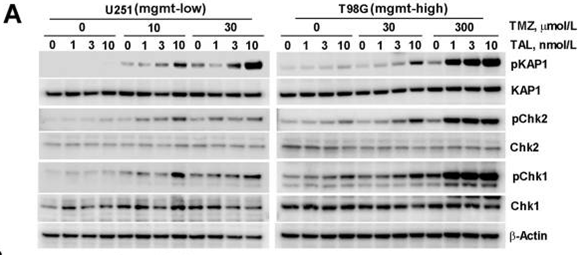
| Western blot | pKAP1 / pChk2 / pChk1 cleaved-PARP / cleaved-caspase3 / γ-H2AX p-ATM PD-L1 |
|
28947502 |
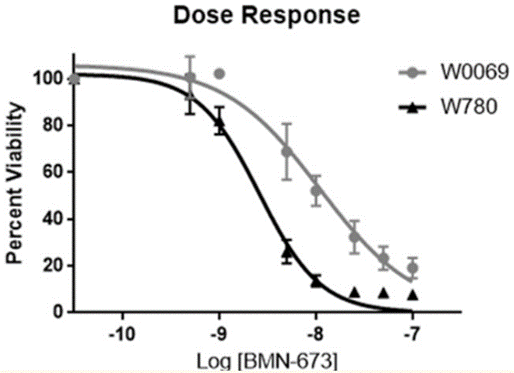
| Growth inhibition assay | Cell viability |
|
29158830 |
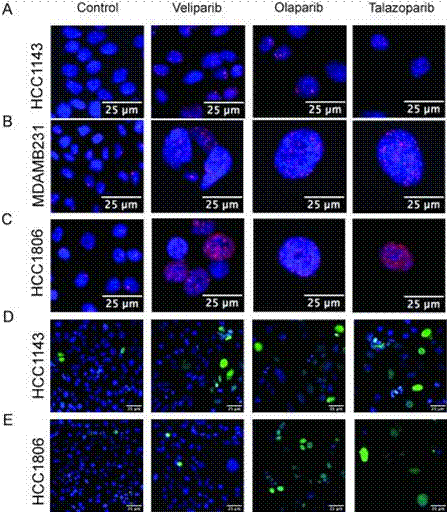
| Immunofluorescence | cleaved PARP / 53BP1 RAD51 |
|
28958991 |
Clinical Trial Information
(data from https://clinicaltrials.gov, updated on 2024-05-22)
| NCT Number | Recruitment | Conditions | Sponsor/Collaborators | Start Date | Phases |
|---|---|---|---|---|---|
| NCT05425862 | Suspended | Metastatic Castration Resistant Prostate Cancer (mCRPC) |
Peter MacCallum Cancer Centre Australia |
October 21 2022 | Phase 1 |
| NCT05141708 | Completed | Metastatic Breast Cancer|Breast Neoplasms |
Pfizer |
December 17 2021 | -- |
| NCT05053854 | Recruiting | Neuroendocrine Tumors |
Peter MacCallum Cancer Centre Australia |
December 8 2021 | Phase 1 |
| NCT04991480 | Active not recruiting | Advanced Cancer|Metastatic Cancer|Breast Cancer |
Artios Pharma Ltd |
September 13 2021 | Phase 1|Phase 2 |
| NCT04987931 | Completed | Breast Cancer |
Pfizer |
August 20 2021 | -- |
Tech Support
Tel: +1-832-582-8158 Ext:3
If you have any other enquiries, please leave a message.
Frequently Asked Questions
Question 1:
Which solvent do you recommend to dilute it for in vivo study in mice?
Answer:
According to the paper: http://clincancerres.aacrjournals.org/content/19/18/5003.full, it can be dissolved in vehicle (10% DMAc, 6% Solutol, and 84% PBS). Quote from Method and Material section "Xenograft experiments: BMN 673 (various doses as indicated), or vehicle (10% DMAc, 6% Solutol, and 84% PBS) was administered by oral gavage"

Products are for research use only. Not for human use. We do not sell to patients.
©Copyright 2013 Selleck Chemicals. All Rights Reserved.