
research use only
T0070907 PPARγ Antagonist
Cat.No.S2871
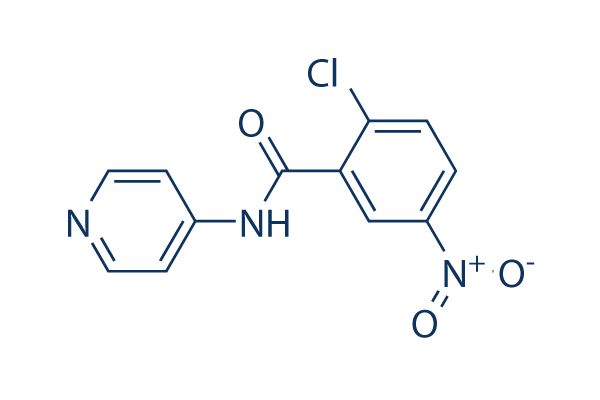
Chemical Structure
Molecular Weight: 277.66
Quality Control
| Related Targets | HDAC PARP ATM/ATR DNA-PK WRN DNA/RNA Synthesis Topoisomerase Sirtuin Casein Kinase eIF |
|---|---|
| Other PPAR Inhibitors | GW9662 GW6471 WY-14643 (Pirinixic Acid) GSK3787 GW0742 AZ6102 Harmine Astaxanthin Eupatilin GSK0660 |
Cell Culture, Treatment & Working Concentration
| Cell Lines | Assay Type | Concentration | Incubation Time | Formulation | Activity Description | PMID |
|---|---|---|---|---|---|---|
| OR6 | Cytotoxicity assay | 72 hrs | Cytotoxicity against african green monkey OR6 cells after 72 hrs by WST1 assay, CC50=2.7μM. | 23891183 | ||
| OR6 | Antiviral assay | 72 hrs | Antiviral activity against HCV infected in african green monkey OR6 cells assessed as inhibition of viral RNA replication after 72 hrs by luciferase reporter gene assay, ED50=4.9μM. | 23891183 | ||
| Click to View More Cell Line Experimental Data | ||||||
Chemical Information, Storage & Stability
| Molecular Weight | 277.66 | Formula | C12H8ClN3O3 |
Storage (From the date of receipt) | |
|---|---|---|---|---|---|
| CAS No. | 313516-66-4 | Download SDF | Storage of Stock Solutions |
|
|
| Synonyms | N/A | Smiles | C1=CC(=C(C=C1[N+](=O)[O-])C(=O)NC2=CC=NC=C2)Cl | ||
Solubility
|
In vitro |
DMSO
: 55 mg/mL
(198.08 mM)
Water : Insoluble Ethanol : Insoluble |
Molarity Calculator
|
In vivo |
|||||
In vivo Formulation Calculator (Clear solution)
Step 1: Enter information below (Recommended: An additional animal making an allowance for loss during the experiment)
Step 2: Enter the in vivo formulation (This is only the calculator, not formulation. Please contact us first if there is no in vivo formulation at the solubility Section.)
Calculation results:
Working concentration: mg/ml;
Method for preparing DMSO master liquid: mg drug pre-dissolved in μL DMSO ( Master liquid concentration mg/mL, Please contact us first if the concentration exceeds the DMSO solubility of the batch of drug. )
Method for preparing in vivo formulation: Take μL DMSO master liquid, next addμL PEG300, mix and clarify, next addμL Tween 80, mix and clarify, next add μL ddH2O, mix and clarify.
Method for preparing in vivo formulation: Take μL DMSO master liquid, next add μL Corn oil, mix and clarify.
Note: 1. Please make sure the liquid is clear before adding the next solvent.
2. Be sure to add the solvent(s) in order. You must ensure that the solution obtained, in the previous addition, is a clear solution before proceeding to add the next solvent. Physical methods such as vortex, ultrasound or hot water bath can be used to aid dissolving.
Mechanism of Action
| Targets/IC50/Ki |
PPARγ
|
|---|---|
| In vitro |
T0070907 is a potent and selective PPARγ antagonist. With an apparent binding affinity of 1 nM, this compound covalently modifies PPARγ on cysteine 313 in helix 3 of human PPARγ2. It blocks PPARγ function in both cell-based reporter gene and adipocyte differentiation assays. Consistent with its role as an antagonist of PPARγ, this chemical blocks agonist-induced recruitment of coactivator-derived peptides to PPARγ in a homogeneous time-resolved fluorescence-based assay and promotes recruitment of the transcriptional corepressor NCoR to PPARγ in both glutathione S-transferase pull-down assays and a PPARγ/retinoid X receptor (RXR) α-dependent gel shift assay. Studies with mutant receptors suggest that it modulates the interaction of PPARγ with these cofactor proteins by affecting the conformation of helix 12 of the PPARγ ligand-binding domain. Interestingly, whereas the T0070907-induced NCoR recruitment to PPARγ/RXRα heterodimer can be almost completely reversed by the simultaneous treatment with RXRα agonist LGD1069, this compound treatment has only modest effects on LGD1069-induced coactivator recruitment to the PPARγ/RXRα heterodimer. This chemical treatment inhibits proliferation, invasion and migration but does not significantly affect apoptosis. Molecular inhibition using a dominant negative (Δ462) receptor yields similar results. It also mediates a dose-dependent decrease in phosphorylation of PPARγ, and its ability to bind to DNA, and may directly affect mitogen-activated protein kinase signaling. |
| Kinase Assay |
Ligand Binding Assay
|
|
To determine the binding affinity of T0070907 to the PPARs, scintillation proximity assay (SPA) is performed with the following modifications. A 90-μl reaction contains SPA buffer (10 mm KH2PO4, 10 mm KH2PO4, 2 mm EDTA, 50 mm NaCl, 1 mm dithiothreitol, 2 mmCHAPS, 10% (v/v) glycerol, pH 7.1), 50 ng of GST-PPARγ (or 150 ng of GST-PPARα, GST-PPARδ), 5 nm 3H-labeled radioligands, and 5 μl of this compound in Me2SO. After incubation for 1 h at room temperature, 10 μl of polylysine-coated SPA beads (at 20 mg/ml in SPA buffer) are added, and the mixtureis incubated for 1 h before reading in Packard Topcount.
|
|
| In vivo |
Lipopolysaccharide preconditioning significantly attenuates the development of renal dysfunction, hepatocellular injury, and circulatory failure as well as the increase in the plasma levels of interleukin-1 [beta] caused by severe endotoxemia. This compound can attenuate all of these beneficial effects afforded by preconditioning with lipopolysaccharide |
References |
|
Tech Support
Tel: +1-832-582-8158 Ext:3
If you have any other enquiries, please leave a message.

Products are for research use only. Not for human use. We do not sell to patients.
©Copyright 2013 Selleck Chemicals. All Rights Reserved.