
research use only
SKLB1002 VEGFR inhibitor
Cat.No.S7258
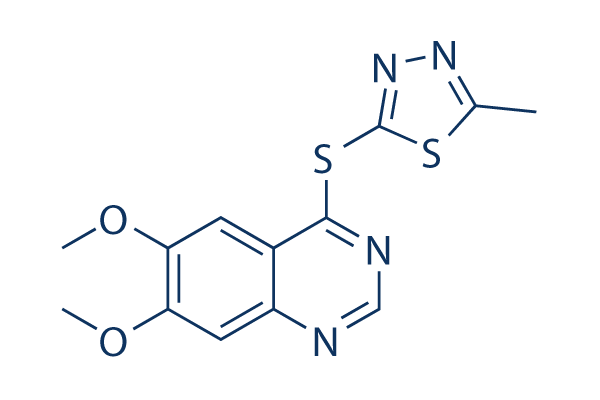
Chemical Structure
Molecular Weight: 320.39
Quality Control
| Related Targets | EGFR PDGFR FGFR c-Met Src MEK CSF-1R FLT3 HER2 c-Kit |
|---|---|
| Other VEGFR Inhibitors | SAR131675 SU 5402 Cediranib (AZD2171) Vatalanib (PTK787) 2HCl Anlotinib (AL3818) Dihydrochloride Linifanib (ABT-869) Apatinib (YN968D1) Apatinib (YN968D1) mesylate Ki8751 ZM 323881 HCl |
Chemical Information, Storage & Stability
| Molecular Weight | 320.39 | Formula | C13H12N4O2S2 |
Storage (From the date of receipt) | |
|---|---|---|---|---|---|
| CAS No. | 1225451-84-2 | -- | Storage of Stock Solutions |
|
|
| Synonyms | N/A | Smiles | CC1=NN=C(S1)SC2=NC=NC3=CC(=C(C=C32)OC)OC | ||
Solubility
|
In vitro |
DMSO
: 4 mg/mL
(12.48 mM)
Water : Insoluble Ethanol : Insoluble |
Molarity Calculator
|
In vivo |
|||||
In vivo Formulation Calculator (Clear solution)
Step 1: Enter information below (Recommended: An additional animal making an allowance for loss during the experiment)
Step 2: Enter the in vivo formulation (This is only the calculator, not formulation. Please contact us first if there is no in vivo formulation at the solubility Section.)
Calculation results:
Working concentration: mg/ml;
Method for preparing DMSO master liquid: mg drug pre-dissolved in μL DMSO ( Master liquid concentration mg/mL, Please contact us first if the concentration exceeds the DMSO solubility of the batch of drug. )
Method for preparing in vivo formulation: Take μL DMSO master liquid, next addμL PEG300, mix and clarify, next addμL Tween 80, mix and clarify, next add μL ddH2O, mix and clarify.
Method for preparing in vivo formulation: Take μL DMSO master liquid, next add μL Corn oil, mix and clarify.
Note: 1. Please make sure the liquid is clear before adding the next solvent.
2. Be sure to add the solvent(s) in order. You must ensure that the solution obtained, in the previous addition, is a clear solution before proceeding to add the next solvent. Physical methods such as vortex, ultrasound or hot water bath can be used to aid dissolving.
Mechanism of Action
| Targets/IC50/Ki |
VEGFR2
32 nM
|
|---|---|
| In vitro |
SKLB1002 shows strikingly lower cytotoxicity on normal human cells L-02. This compound significantly inhibits HUVEC proliferation, migration, invasion, and tube formation, by inhibiting VEGF-induced phosphorylation of VEGFR2 kinase and the downstream Protein Tyrosine Kinase including ERK, FAK, and Src.
|
| Kinase Assay |
Kinase inhibition assays
|
|
Kinase inhibition is measured by the use of radiometric assays conducted by Kinase Profiler service. Briefly, in the presence or absence of SKLB1002, VGFR2 (5–10 mU) is incubated in 25-μL reaction solution containing 8 mmol/L 3-(N-morpholino)propanesulfonic acid (MOPS), pH 7.0, 0.2 mmol/L EDTA, 0.33 mg/mL myelin basic protein, 10 mmol/L Mg acetate, and γ-[33P]ATP. After incubation for 40 minutes at room temperature, the reaction is stopped and 10 μL of the reaction solution is then spotted onto a P30 filtermat and washed 3 times for 5 minutes in 75 mmol/L phosphoric acid and once in methanol prior to scintillation counting.
|
|
| In vivo |
In the zebrafish embryos, SKLB1002 remarkably blocks the formation of embryonic and tumour-induced angiogenesis with no or least impact on normal cell proliferation. In athymic mice bearing SW620 or HepG2 xenografts, this compound (100 mg/kg daily, i.p.) causes significant inhibition of tumour growth, inhibits tumour angiogenesis and induces tumour apoptosis. In 4T1 and CT26 tumour model, this chemical and local hyperthermia produce a synergistic antiangiogenesis, anticancer and promotion of apoptosis efficacy.
|
References |
|
Tech Support
Tel: +1-832-582-8158 Ext:3
If you have any other enquiries, please leave a message.

Products are for research use only. Not for human use. We do not sell to patients.
©Copyright 2013 Selleck Chemicals. All Rights Reserved.