
research use only
PF-06273340 Trk receptor inhibitor
Cat.No.S8407
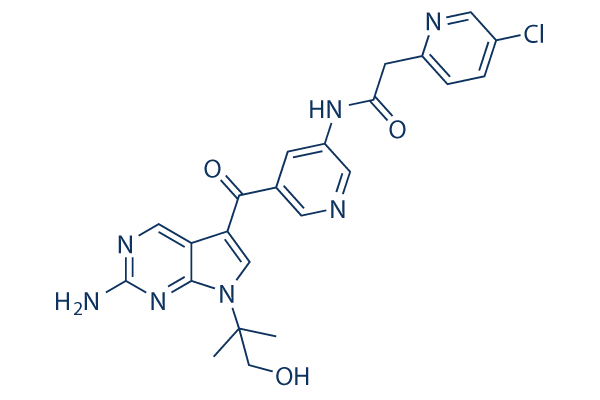
Chemical Structure
Molecular Weight: 479.92
Quality Control
| Related Targets | EGFR VEGFR PDGFR FGFR c-Met Src MEK CSF-1R FLT3 HER2 |
|---|---|
| Other Trk receptor Inhibitors | ANA-12 GW441756 7,8-Dihydroxyflavone GNF-5837 Selitrectinib (LOXO-195) Altiratinib LM22B-10 N-Acetyl-5-hydroxytryptamine CH7057288 LM22A-4 |
Chemical Information, Storage & Stability
| Molecular Weight | 479.92 | Formula | C23H22ClN7O3 |
Storage (From the date of receipt) | |
|---|---|---|---|---|---|
| CAS No. | 1402438-74-7 | Download SDF | Storage of Stock Solutions |
|
|
| Synonyms | N/A | Smiles | CC(C)(CO)N1C=C(C2=CN=C(N=C21)N)C(=O)C3=CC(=CN=C3)NC(=O)CC4=NC=C(C=C4)Cl | ||
Solubility
|
In vitro |
DMSO
: 95 mg/mL
(197.94 mM)
Ethanol : 1 mg/mL Water : Insoluble |
Molarity Calculator
|
In vivo |
|||||
In vivo Formulation Calculator (Clear solution)
Step 1: Enter information below (Recommended: An additional animal making an allowance for loss during the experiment)
Step 2: Enter the in vivo formulation (This is only the calculator, not formulation. Please contact us first if there is no in vivo formulation at the solubility Section.)
Calculation results:
Working concentration: mg/ml;
Method for preparing DMSO master liquid: mg drug pre-dissolved in μL DMSO ( Master liquid concentration mg/mL, Please contact us first if the concentration exceeds the DMSO solubility of the batch of drug. )
Method for preparing in vivo formulation: Take μL DMSO master liquid, next addμL PEG300, mix and clarify, next addμL Tween 80, mix and clarify, next add μL ddH2O, mix and clarify.
Method for preparing in vivo formulation: Take μL DMSO master liquid, next add μL Corn oil, mix and clarify.
Note: 1. Please make sure the liquid is clear before adding the next solvent.
2. Be sure to add the solvent(s) in order. You must ensure that the solution obtained, in the previous addition, is a clear solution before proceeding to add the next solvent. Physical methods such as vortex, ultrasound or hot water bath can be used to aid dissolving.
Mechanism of Action
| Targets/IC50/Ki |
TrkC
(Cell-free assay) 3 nM
TrkB
(Cell-free assay) 4 nM
TrkA
(Cell-free assay) 6 nM
|
|---|---|
| In vitro |
PF-06273340 is a highly potent pan-Trk inhibitor, with an excellent LipE profile. This compound is profiled in a series of in vitro safety assays, showing little cytotoxicity in THLE or HepG2 cell lines (IC50 > 42 μM and >300 μM, respectively). In this broad panel, all IC50/Ki values were >10 μM except for COX-1 (IC50 = 2.7 μM) and dopamine transporter assays (Ki = 5.2 μM) and PDEs 4D, 5A, 7B, 8B, and 11 (54−89% inhibition at 10 μM). This chemical is screened in the Invitrogen wide kinase panel of 309 kinases, and all were inhibited by <40% when tested at 1 μM except the following: MUSK (IC50 53 nM), FLT-3 (IC50 395 nM), IRAK1 (IC50 2.5 μM), MKK (90% @ 1 μM), and DDR1 (60% @ 1 μM).
|
| In vivo |
In rats, decreases in white blood cell count are observed from 150 mg/kg/day. At doses ≥250 mg/kg, increases in body weight gain and food consumption are observed, effects that could be rationalised as being mediated by central inhibition of TrkB, agonists of which are known to be anorexigenic in rodents. Adaptive changes in the liver are observed microscopically and accompanied by increased liver weight at ≥250 mg/kg and increased cholesterol at 1000 mg/kg. Overall, this compound is well tolerated up to 1000 mg/kg/day where plasma exposure (unbound Cavg) is approximately 400×TrkA IC50.
|
References |
Tech Support
Tel: +1-832-582-8158 Ext:3
If you have any other enquiries, please leave a message.

Products are for research use only. Not for human use. We do not sell to patients.
©Copyright 2013 Selleck Chemicals. All Rights Reserved.