
research use only
Ki16198 LPA Receptor antagonist
Cat.No.S2906
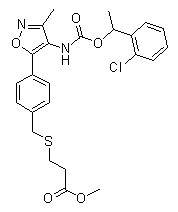
Chemical Structure
Molecular Weight: 488.98
Quality Control
| Related Targets | CXCR Hedgehog/Smoothened PKA Adrenergic Receptor AChR 5-HT Receptor Histamine Receptor Dopamine Receptor Ras KRas |
|---|---|
| Other LPA Receptor Inhibitors | Ki16425 ONO-7300243 AM 095 BMS-986020 Oleoyl-L-alpha-lysophosphatidic acid sodium salt BMS-986278 ACT-1016-0707 AM966 |
Chemical Information, Storage & Stability
| Molecular Weight | 488.98 | Formula | C24H25ClN2O5S |
Storage (From the date of receipt) | |
|---|---|---|---|---|---|
| CAS No. | 355025-13-7 | Download SDF | Storage of Stock Solutions |
|
|
| Synonyms | N/A | Smiles | CC1=NOC(=C1NC(=O)OC(C)C2=CC=CC=C2Cl)C3=CC=C(C=C3)CSCCC(=O)OC | ||
Solubility
|
In vitro |
DMSO
: 98 mg/mL
(200.41 mM)
Ethanol : 98 mg/mL Water : Insoluble |
Molarity Calculator
|
In vivo |
|||||
In vivo Formulation Calculator (Clear solution)
Step 1: Enter information below (Recommended: An additional animal making an allowance for loss during the experiment)
Step 2: Enter the in vivo formulation (This is only the calculator, not formulation. Please contact us first if there is no in vivo formulation at the solubility Section.)
Calculation results:
Working concentration: mg/ml;
Method for preparing DMSO master liquid: mg drug pre-dissolved in μL DMSO ( Master liquid concentration mg/mL, Please contact us first if the concentration exceeds the DMSO solubility of the batch of drug. )
Method for preparing in vivo formulation: Take μL DMSO master liquid, next addμL PEG300, mix and clarify, next addμL Tween 80, mix and clarify, next add μL ddH2O, mix and clarify.
Method for preparing in vivo formulation: Take μL DMSO master liquid, next add μL Corn oil, mix and clarify.
Note: 1. Please make sure the liquid is clear before adding the next solvent.
2. Be sure to add the solvent(s) in order. You must ensure that the solution obtained, in the previous addition, is a clear solution before proceeding to add the next solvent. Physical methods such as vortex, ultrasound or hot water bath can be used to aid dissolving.
Mechanism of Action
| Targets/IC50/Ki |
LPA1
0.34 μM(Ki)
LPA3
0.93 μM(Ki)
|
|---|---|
| In vitro |
Ki16198 or Ki16425 substantially inhibits LPA1- and LPA3-mediated responses with a similar potency, with low potency to LPA2 and no activity to LPA4, LPA5 and LPA6. This compound (10 μM) is also effective to inhibit migration and invasion responses to LPA in YAPC-PD cancer cell line with a potency similar to that of Ki16425. It (10 μM) inhibits the LPA-induced expression of proMMP-9 protein and mRNA in YAPC-PD cells. This chemical (1 μM) inhibits the proliferation of lpa1Δ-1 and lpa1Δ+-1 cells by about 70%.
|
| Kinase Assay |
Inositolphosphate response
|
|
RH7777 cells expressing LPA1, LPA2, LPA3, LPA4, or LPA5 are cultured on collagen-coated 12-well dishes in the growth medium, and then the medium is changed to TCM199 containing 2 μCi/mL [3H]inositol and 0.1% (w/v) BSA (fraction V). After 24 h later, the cells are washed three times with HEPES-buffered medium, which consisted of 20 mM Hepes (pH 7.4), 134 mM NaCl, 4.7 mM KCl, 1.2 mM KH2PO4, 1.2 mM MgSO4, 2 mM CaCl2, 2.5 mM NaHCO3, 5 mM glucose, and 0.1% (w/v) BSA, and incubated for 30 min with the indicated concentrations of Ki16425 or Ki16198 with or without 1 μM LPA in the presence of 10 mM LiCl in the same medium at final volume of 0.5 mL. The reaction is terminated by adding 1 N HCl (0.1 mL) and freezing the cells. The supernatant (acid extract in 0.5 mL) of the thawed cells is used for the separation of [3H]inositol phosphate fractions. The results are normalized to 105 dpm of the total radioactivity incorporated into the cellular inositol lipids. The radioactivity of the trichloroacetic acid (5%)-insoluble fraction is measured as the total radioactivity.
|
|
| In vivo |
Ki16198 (2 mg/kg) significantly decreases the total metastatic node weight in the peritoneal cavity and ascites formation by 50% in YAPC-PD xenograft mouse model. This compound (60 mg/kg orally) significantly inhibits lactate-induced limb lesions in rats.
|
References |
|
Tech Support
Tel: +1-832-582-8158 Ext:3
If you have any other enquiries, please leave a message.

Products are for research use only. Not for human use. We do not sell to patients.
©Copyright 2013 Selleck Chemicals. All Rights Reserved.