
research use only
Adaptavir (DAPTA) CCR antagonist
Cat.No.S8501
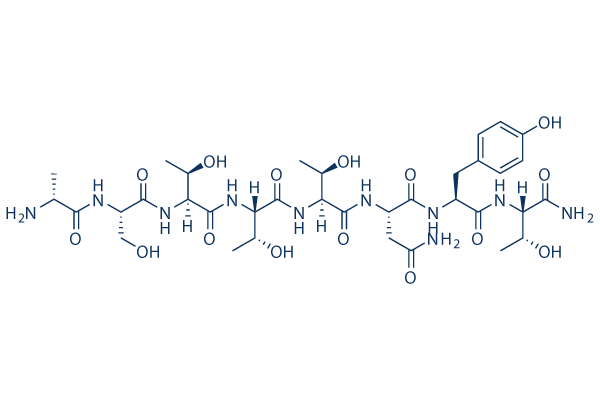
Chemical Structure
Molecular Weight: 856.88
Quality Control
| Related Targets | PD-1/PD-L1 CXCR STING AhR Immunology & Inflammation related CD markers Interleukins Anti-infection Antioxidant COX |
|---|---|
| Other CCR Inhibitors | Cenicriviroc INCB3344 Vicriviroc Malate ZK756326 2HCl BMS-813160 SB-297006 RS102895 BX471 (ZK-811752) AZD2098 R243 |
Chemical Information, Storage & Stability
| Molecular Weight | 856.88 | Formula | C35H56N10O15 |
Storage (From the date of receipt) | |
|---|---|---|---|---|---|
| CAS No. | 106362-34-9 | Download SDF Download SDF | Storage of Stock Solutions |
|
|
| Synonyms | D-Ala-peptide T-amide, peptide T | Smiles | CC(C(C(=O)N)NC(=O)C(CC1=CC=C(C=C1)O)NC(=O)C(CC(=O)N)NC(=O)C(C(C)O)NC(=O)C(C(C)O)NC(=O)C(C(C)O)NC(=O)C(CO)NC(=O)C(C)N)O | ||
Solubility
|
In vitro |
Water : 100 mg/mL |
Molarity Calculator
|
In vivo |
|||||
In vivo Formulation Calculator (Clear solution)
Step 1: Enter information below (Recommended: An additional animal making an allowance for loss during the experiment)
Step 2: Enter the in vivo formulation (This is only the calculator, not formulation. Please contact us first if there is no in vivo formulation at the solubility Section.)
Calculation results:
Working concentration: mg/ml;
Method for preparing DMSO master liquid: mg drug pre-dissolved in μL DMSO ( Master liquid concentration mg/mL, Please contact us first if the concentration exceeds the DMSO solubility of the batch of drug. )
Method for preparing in vivo formulation: Take μL DMSO master liquid, next addμL PEG300, mix and clarify, next addμL Tween 80, mix and clarify, next add μL ddH2O, mix and clarify.
Method for preparing in vivo formulation: Take μL DMSO master liquid, next add μL Corn oil, mix and clarify.
Note: 1. Please make sure the liquid is clear before adding the next solvent.
2. Be sure to add the solvent(s) in order. You must ensure that the solution obtained, in the previous addition, is a clear solution before proceeding to add the next solvent. Physical methods such as vortex, ultrasound or hot water bath can be used to aid dissolving.
Mechanism of Action
| Targets/IC50/Ki |
gp120 Bal-CCR5
(Cell-free assay) 0.06 nM
CM235-CCR5
(Cell-free assay) 0.32 nM
|
|---|---|
| In vitro |
Adaptavir (DAPTA) is a non-toxic experimental antiviral entry inhibitor that potently inhibits specific CD4-dependent binding of gp120 Bal (IC50 = 0.06 nM) and CM235 (IC50 = 0.32 nM) to CCR5. In co-immunoprecipitation studies, this compound (1 nM) blocks formation of the gp120/sCD4 complex with CCR5. Confocal microscopic studies of direct FITC-DAPTA binding to CCR5+, but not CCR5−, cells show that CCR5 is a DAPTA receptor. It is an antagonist of CCR5-mediated chemotaxis and is most effective as an antiviral agent primarily against R5-tropic HIV-1 isolates, with reduced or absent effect for X4-tropic laboratory isolates. DAPTA does not inhibit fusion in typical assays, which use high local concentrations of virus and cells. The Th2 cytokines IL-4, IL-10,and IL-13, are increased by this compound and induce a potent virostatic state in infected macrophages in vitro, as well as inhibit production of the proinflammatory cytokines IL-1 and TNFα, which upregulate virus expression. Thus the elevation of Th2 cytokines by DAPTA treatment would favor less macrophage viral replication.
|
| In vivo |
Following DAPTA treatment, the levels of inflammatory cytokines IL-1, IL-6, and TNFα decrease in plasma. This compound also prevents the neuronal cell death associated with gpl20 and prevents gpl20-associated neural deficits in vivo.
|
References |
|
Clinical Trial Information
(data from https://clinicaltrials.gov, updated on 2024-05-22)
| NCT Number | Recruitment | Conditions | Sponsor/Collaborators | Start Date | Phases |
|---|---|---|---|---|---|
| NCT00951743 | Unknown status | HIV Infections |
Rapid Laboratories Inc. |
July 2009 | Phase 2 |
Tech Support
Tel: +1-832-582-8158 Ext:3
If you have any other enquiries, please leave a message.

Products are for research use only. Not for human use. We do not sell to patients.
©Copyright 2013 Selleck Chemicals. All Rights Reserved.