
research use only
BMS-378806 gp120/CD4 inhibitor
Cat.No.S2632
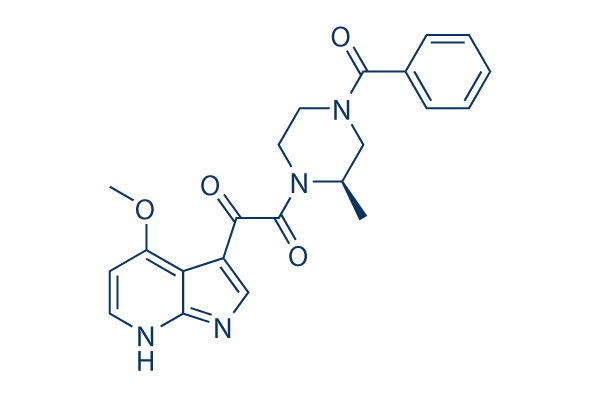
Chemical Structure
Molecular Weight: 406.43
Quality Control
| Related Targets | PD-1/PD-L1 CXCR STING AhR Immunology & Inflammation related CD markers Interleukins Anti-infection Antioxidant COX |
|---|---|
| Other gp120/CD4 Inhibitors | YYA-021 Fostemsavir HIV Peptide T |
Chemical Information, Storage & Stability
| Molecular Weight | 406.43 | Formula | C22H22N4O4 |
Storage (From the date of receipt) | |
|---|---|---|---|---|---|
| CAS No. | 357263-13-9 | Download SDF | Storage of Stock Solutions |
|
|
| Synonyms | BMS 806 | Smiles | CC1CN(CCN1C(=O)C(=O)C2=CNC3=NC=CC(=C23)OC)C(=O)C4=CC=CC=C4 | ||
Solubility
|
In vitro |
DMSO
: 81 mg/mL
(199.29 mM)
Ethanol : 81 mg/mL Water : Insoluble |
Molarity Calculator
|
In vivo |
|||||
In vivo Formulation Calculator (Clear solution)
Step 1: Enter information below (Recommended: An additional animal making an allowance for loss during the experiment)
Step 2: Enter the in vivo formulation (This is only the calculator, not formulation. Please contact us first if there is no in vivo formulation at the solubility Section.)
Calculation results:
Working concentration: mg/ml;
Method for preparing DMSO master liquid: mg drug pre-dissolved in μL DMSO ( Master liquid concentration mg/mL, Please contact us first if the concentration exceeds the DMSO solubility of the batch of drug. )
Method for preparing in vivo formulation: Take μL DMSO master liquid, next addμL PEG300, mix and clarify, next addμL Tween 80, mix and clarify, next add μL ddH2O, mix and clarify.
Method for preparing in vivo formulation: Take μL DMSO master liquid, next add μL Corn oil, mix and clarify.
Note: 1. Please make sure the liquid is clear before adding the next solvent.
2. Be sure to add the solvent(s) in order. You must ensure that the solution obtained, in the previous addition, is a clear solution before proceeding to add the next solvent. Physical methods such as vortex, ultrasound or hot water bath can be used to aid dissolving.
Mechanism of Action
| Targets/IC50/Ki |
CD4-gp120 interactions
0.85 nM-26.5 nM(EC50)
|
|---|---|
| In vitro |
BMS-806, a 7-azaindole derivative, binds gp120 and interferes with the interaction of HIV surface protein gp120 with the host cell receptor CD4. BMS-806 inhibits a panel of macrophage- and T cell-tropic HIV-1 strains, which are laboratory strains that use either CCR5 (M-tropic) or CXR4 (T-tropic) co-receptors to enter cells and are classified as B subtypes. The aqueous solubility from the crystalline form of BMS-806 (BMS 378806) is 170 μg/mL. The solubility of BMS-806 is 1.3 mg/mL at pH=2.1 and 3.3 mg/mL at pH=11, a solubility profile that reveals the amphoteric nature of BMS-806 and estimates the pKa of the protonated form as 2.9 while that of the free base is approximately 9.6. BMS-806 competes with soluble CD4 binding to a monomeric form of gp120 in an ELISA assay with IC50 = ~ 100 nM. BMS-806 is specific towards HIV-1, with no significant inhibitory activity against HIV-2, SIV, MuLV, RSV, HCMV, BVDV, VSV, and influenza virus observed at concentrations ranging from 10 to 30 μM and no overt cytotoxicity toward host cells, CC50 values > 225 μM. BMS-806 binds directly to gp120 at a stoichiometry of approximately 1:1, with a binding affinity similar to that of soluble CD4. The potential BMS-806 target site is localised to a specific region within the CD4 binding pocket of gp120 by using HIV-1 gp120 variants carrying either compound-selected resistant substitutions or gp120-CD4 contact site mutations.
|
| Kinase Assay |
Drug susceptibility Assay
|
|
In general, host cells are infected with HIV-1 at a multiplicity of infection (MOI) of 0.005 50% tissue culture infective doses (TCID50)/cell followed by incubation in the presence of serially diluted inhibitors for 4 to 7 days. Virus yields are quantitated using an RT assay or a p24 enzyme-linked immunosorbent assay (ELISA) (NEN). The results from at least three experiments are used to calculate the 50% effective concentrations (EC50s). The EC50s of IDV, SQV, RTV, and NFV are compared to that of BMS-806 using Dunnett's test. These comparisons are made separately within each assay system. Dunnett's test is used to reduce the probability of false-positive results when a number of treatments are being compared to a control. Confidence bounds for the fold increases in EC50s observed when the same drug is tested in two different assay systems are computed using Fieller's theorem. The use of this theorem is necessary because ratios of parameters (in this case, EC50s) are known not to follow a standard probability distribution, such as the normal distribution. Numbers within the confidence interval are not significantly different from the observed fold increase at the 95% level.
|
|
| In vivo |
When BMS-806 is administered dose-proportional increases in the AUC and Cmax are observed. In rat, dog and monkey, plasma levels of drug exceeded the concentrations required to half-maximally inhibit virus replication in vitro. The volume of distribution of BMS-806 ranges from 0.4 to 0.6 L/kg, indicative of partitioning beyond plasma; however, examination of brain levels in the rat revealed minimal CNS penetration. BMS-806 is stable in human, rat, dog and monkey blood at 37 °C during a 2-h incubation. The blood-to-plasma concentration ratios in humans, rats, dogs and monkeys are 1.1, 0.77, 1.2 and 0.92 (n=3), respectively, suggesting that BMS-806 is distributed to approximately the same extent between plasma and blood cells. The human clearance of BMS-806 predicted from microsomes is 9.2 ml/min/kg (46% of the hepatic blood flow).
|
References |
|
Tech Support
Tel: +1-832-582-8158 Ext:3
If you have any other enquiries, please leave a message.

Products are for research use only. Not for human use. We do not sell to patients.
©Copyright 2013 Selleck Chemicals. All Rights Reserved.