
research use only
AZD3463 ALK inhibitor
Cat.No.S7106
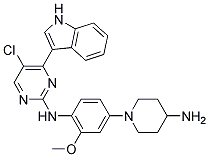
Chemical Structure
Molecular Weight: 448.95
Quality Control
| Related Targets | EGFR VEGFR PDGFR FGFR c-Met Src MEK CSF-1R FLT3 HER2 |
|---|---|
| Other ALK Inhibitors | TAE684 (NVP-TAE684) GSK1838705A Repotrectinib (TPX-0005) Ensartinib dihydrochloride AP26113-analog (ALK-IN-1) ASP3026 NVL-655 (Neladalkib) Envonalkib Belizatinib (TSR-011) HG-14-10-04 |
Chemical Information, Storage & Stability
| Molecular Weight | 448.95 | Formula | C24H25ClN6O |
Storage (From the date of receipt) | |
|---|---|---|---|---|---|
| CAS No. | 1356962-20-3 | Download SDF | Storage of Stock Solutions |
|
|
| Synonyms | N/A | Smiles | COC1=C(C=CC(=C1)N2CCC(CC2)N)NC3=NC=C(C(=N3)C4=CNC5=CC=CC=C54)Cl | ||
Solubility
|
In vitro |
DMSO
: 6 mg/mL
(13.36 mM)
Water : Insoluble Ethanol : Insoluble |
Molarity Calculator
|
In vivo |
|||||
In vivo Formulation Calculator (Clear solution)
Step 1: Enter information below (Recommended: An additional animal making an allowance for loss during the experiment)
Step 2: Enter the in vivo formulation (This is only the calculator, not formulation. Please contact us first if there is no in vivo formulation at the solubility Section.)
Calculation results:
Working concentration: mg/ml;
Method for preparing DMSO master liquid: mg drug pre-dissolved in μL DMSO ( Master liquid concentration mg/mL, Please contact us first if the concentration exceeds the DMSO solubility of the batch of drug. )
Method for preparing in vivo formulation: Take μL DMSO master liquid, next addμL PEG300, mix and clarify, next addμL Tween 80, mix and clarify, next add μL ddH2O, mix and clarify.
Method for preparing in vivo formulation: Take μL DMSO master liquid, next add μL Corn oil, mix and clarify.
Note: 1. Please make sure the liquid is clear before adding the next solvent.
2. Be sure to add the solvent(s) in order. You must ensure that the solution obtained, in the previous addition, is a clear solution before proceeding to add the next solvent. Physical methods such as vortex, ultrasound or hot water bath can be used to aid dissolving.
Mechanism of Action
| Targets/IC50/Ki |
IGF-1R
ALK
0.75 nM(Ki)
|
|---|---|
| In vitro |
AZD3463 is potent in ALK-driven preclinical models and in a variety of crizotinib-resistant models. This compound inhibits ALK in cells as demonstrated by its ability to decrease ALK autophosphorylation in tumour cell lines containing ALK fusions including DEL (ALCL NPM-ALK), H3122 (NSCLC EML4-ALK) and H2228 (NSCLC EML4-ALK). Inhibition of ALK is associated with perturbations in downstream signalling including ERK, AKT and STAT3 pathways leading to preferential inhibition of proliferation in the ALK fusion containing cell lines in vitro. It retains good activity against a number of clinically relevant crizotinib resistant mutations including the gatekeeper mutant L1196M where equivalent potency to wild type ALK is observed in vitro and in vivo in EML4-ALK containing BAF3 cell lines. To further assess the potential ability of this chemical to overcome additional resistance mechanisms, antiproliferative activity is assessed in multiple crizotinib resistant cell lines independently derived in vitro from H3122 cells as well as a patient derived crizotinib relapsed model. These resistant cell lines contain multiple resistance mechanisms including the L1196M gatekeeper and T115Ins mutations, ALK amplification and/or secondary drivers including EGFR and IGF1R. This compound retains antiproliferative potency within 4 fold of parental H3122 cells for 10 out of 12 of these acquired resistance models in vitro.
|
| In vivo |
AZD3463 also demonstrates the ability to dose dependently inhibit pALK in xenograft tumours in vivo resulting in stasis (H3122) or regression (DEL, H2228).
|
References |
|
Tech Support
Tel: +1-832-582-8158 Ext:3
If you have any other enquiries, please leave a message.

Products are for research use only. Not for human use. We do not sell to patients.
©Copyright 2013 Selleck Chemicals. All Rights Reserved.