
research use only
Tivozanib VEGFR inhibitor
Cat.No.S1207
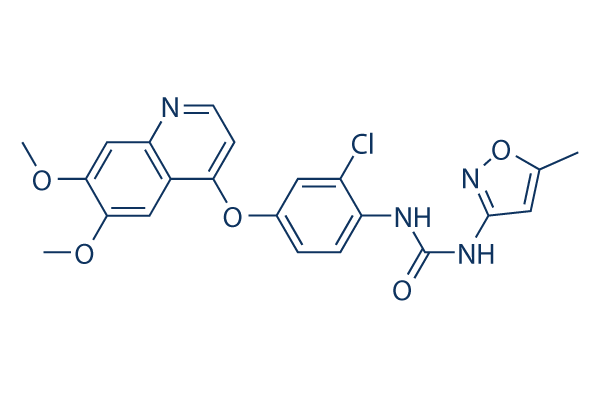
Chemical Structure
Molecular Weight: 454.86
Quality Control
| Related Targets | EGFR PDGFR FGFR c-Met Src MEK CSF-1R FLT3 HER2 c-Kit |
|---|---|
| Other VEGFR Inhibitors | SAR131675 SU 5402 Cediranib (AZD2171) Vatalanib (PTK787) 2HCl Anlotinib (AL3818) Dihydrochloride Linifanib (ABT-869) Apatinib (YN968D1) Apatinib (YN968D1) mesylate Ki8751 ZM 323881 HCl |
Cell Culture, Treatment & Working Concentration
| Cell Lines | Assay Type | Concentration | Incubation Time | Formulation | Activity Description | PMID |
|---|---|---|---|---|---|---|
| MCF7 cells | Proliferation assay | Antiproliferative activity against human MCF7 cells, IC50=0.38 μM | 24583357 | |||
| DAOY | qHTS assay | qHTS of pediatric cancer cell lines to identify multiple opportunities for drug repurposing: Primary screen for DAOY cells | 29435139 | |||
| SJ-GBM2 | qHTS assay | qHTS of pediatric cancer cell lines to identify multiple opportunities for drug repurposing: Primary screen for SJ-GBM2 cells | 29435139 | |||
| BT-37 | qHTS assay | qHTS of pediatric cancer cell lines to identify multiple opportunities for drug repurposing: Primary screen for BT-37 cells | 29435139 | |||
| NB-EBc1 | qHTS assay | qHTS of pediatric cancer cell lines to identify multiple opportunities for drug repurposing: Primary screen for NB-EBc1 cells | 29435139 | |||
| U-2 OS | qHTS assay | qHTS of pediatric cancer cell lines to identify multiple opportunities for drug repurposing: Primary screen for U-2 OS cells | 29435139 | |||
| Saos-2 | qHTS assay | qHTS of pediatric cancer cell lines to identify multiple opportunities for drug repurposing: Primary screen for Saos-2 cells | 29435139 | |||
| SK-N-SH | qHTS assay | qHTS of pediatric cancer cell lines to identify multiple opportunities for drug repurposing: Primary screen for SK-N-SH cells | 29435139 | |||
| LAN-5 | qHTS assay | qHTS of pediatric cancer cell lines to identify multiple opportunities for drug repurposing: Primary screen for LAN-5 cells | 29435139 | |||
| Rh18 | qHTS assay | qHTS of pediatric cancer cell lines to identify multiple opportunities for drug repurposing: Primary screen for Rh18 cells | 29435139 | |||
| OHS-50 | qHTS assay | qHTS of pediatric cancer cell lines to identify multiple opportunities for drug repurposing: Primary screen for OHS-50 cells | 29435139 | |||
| RD | qHTS assay | qHTS of pediatric cancer cell lines to identify multiple opportunities for drug repurposing: Primary screen for RD cells | 29435139 | |||
| Rh41 | qHTS assay | qHTS of pediatric cancer cell lines to identify multiple opportunities for drug repurposing: Primary screen for Rh41 cells | 29435139 | |||
| A673 | qHTS assay | qHTS of pediatric cancer cell lines to identify multiple opportunities for drug repurposing: Confirmatory screen for A673 cells) | 29435139 | |||
| SK-N-MC | qHTS assay | qHTS of pediatric cancer cell lines to identify multiple opportunities for drug repurposing: Confirmatory screen for SK-N-MC cells | 29435139 | |||
| TC32 | qHTS assay | qHTS of pediatric cancer cell lines to identify multiple opportunities for drug repurposing: Confirmatory screen for TC32 cells | 29435139 | |||
| SK-N-SH | qHTS assay | qHTS of pediatric cancer cell lines to identify multiple opportunities for drug repurposing: Confirmatory screen for SK-N-SH cells | 29435139 | |||
| Click to View More Cell Line Experimental Data | ||||||
Chemical Information, Storage & Stability
| Molecular Weight | 454.86 | Formula | C22H19ClN4O5 |
Storage (From the date of receipt) | |
|---|---|---|---|---|---|
| CAS No. | 475108-18-0 | Download SDF | Storage of Stock Solutions |
|
|
| Synonyms | AV-951, KRN-951 | Smiles | CC1=CC(=NO1)NC(=O)NC2=C(C=C(C=C2)OC3=C4C=C(C(=CC4=NC=C3)OC)OC)Cl | ||
Solubility
|
In vitro |
DMSO
: 20 mg/mL
(43.96 mM)
Water : Insoluble Ethanol : Insoluble |
Molarity Calculator
|
In vivo |
|||||
In vivo Formulation Calculator (Clear solution)
Step 1: Enter information below (Recommended: An additional animal making an allowance for loss during the experiment)
Step 2: Enter the in vivo formulation (This is only the calculator, not formulation. Please contact us first if there is no in vivo formulation at the solubility Section.)
Calculation results:
Working concentration: mg/ml;
Method for preparing DMSO master liquid: mg drug pre-dissolved in μL DMSO ( Master liquid concentration mg/mL, Please contact us first if the concentration exceeds the DMSO solubility of the batch of drug. )
Method for preparing in vivo formulation: Take μL DMSO master liquid, next addμL PEG300, mix and clarify, next addμL Tween 80, mix and clarify, next add μL ddH2O, mix and clarify.
Method for preparing in vivo formulation: Take μL DMSO master liquid, next add μL Corn oil, mix and clarify.
Note: 1. Please make sure the liquid is clear before adding the next solvent.
2. Be sure to add the solvent(s) in order. You must ensure that the solution obtained, in the previous addition, is a clear solution before proceeding to add the next solvent. Physical methods such as vortex, ultrasound or hot water bath can be used to aid dissolving.
Mechanism of Action
| Targets/IC50/Ki |
VEGFR2
(Cell-free assay) 6.5 nM
VEGFR3
(Cell-free assay) 15 nM
EphB2
(Cell-free assay) 24 nM
VEGFR1
(Cell-free assay) 30 nM
PDGFRα
(Cell-free assay) 40 nM
PDGFRβ
(Cell-free assay) 49 nM
c-Kit
(Cell-free assay) 78 nM
Tie-2
(Cell-free assay) 78 nM
EphB4
(Cell-free assay) 480 nM
FGFR1
(Cell-free assay) 530 nM
c-Met
(Cell-free assay) 550 nM
Abl
(Cell-free assay) 620 nM
|
|---|---|
| In vitro |
AV-951 is a novel quinoline-urea derivative. AV-951 blocks VEGF-dependent activation of mitogen-activated protein kinases and proliferation of endothelial cells.
|
| Kinase Assay |
Kinase Assays
|
|
Cell-free kinase assays are done in quadruplicate with 1 μM ATP to determine the IC50 values of AV-951 against a variety of recombinant receptor and nonreceptor tyrosine kinases including VEGFR1, VEGFR2, VEGFR3, c-Kit, PDGFRβ, Flt-3 and FGFR1.
|
|
| In vivo |
In vivo studies show that AV-951 also decreases the micro vessel density and suppresses VEGFR2 phosphorylation levels in tumour xenografts, especially at a concentration of 1mg/kg (p.o. administration). AV-951 shows almost complete inhibition of tumour xenografts growth (TGI>85%) in athymic rats. Another study in rat peritoneal disseminated tumour model shows that AV-951 could prolong the survival of the tumour-bearing rats with the MST of 53.5 days. AV-951 displays antitumor activity against many human tumour xenografts including lung, breast, colon, ovarian, pancreas and prostate cancer.
|
References |
|
Clinical Trial Information
(data from https://clinicaltrials.gov, updated on 2024-05-22)
| NCT Number | Recruitment | Conditions | Sponsor/Collaborators | Start Date | Phases |
|---|---|---|---|---|---|
| NCT04645160 | Recruiting | Cholangiocarcinoma|Bile Duct Neoplasm|Biliary Tract Malignancy |
National Cancer Institute (NCI)|National Institutes of Health Clinical Center (CC) |
March 4 2022 | Phase 1|Phase 2 |
| NCT03136627 | Completed | Carcinoma Renal Cell |
AVEO Pharmaceuticals Inc.|Bristol-Myers Squibb |
March 22 2017 | Phase 1|Phase 2 |
| NCT01853644 | Completed | Recurrent Epithelial Ovarian Cancer|Recurrent Fallopian Tube Cancer|Recurrent Primary Peritoneal Cancer |
Northwestern University|National Comprehensive Cancer Network |
June 6 2013 | Phase 2 |
| NCT01834183 | Withdrawn | Renal Cell Carcinoma |
Dana-Farber Cancer Institute |
June 2013 | Phase 2 |
| NCT01807156 | Terminated | Hepatocellular Cancer |
Emory University|AVEO Pharmaceuticals Inc. |
March 2013 | Phase 2 |
Tech Support
Tel: +1-832-582-8158 Ext:3
If you have any other enquiries, please leave a message.
Frequently Asked Questions
Question 1:
Would you please provide a little bit more detail regarding how to prepare it for in vivo treatment and the storage condition?
Answer:
For in vivo formula, we recommend to use 2% DMSO+30% PEG 300+ddH2O up to 1mg/mL. Once dissolved in solution, please make small aliquots and store them at -80C up to 6 months without repeated thawing and refreezing.

Products are for research use only. Not for human use. We do not sell to patients.
©Copyright 2013 Selleck Chemicals. All Rights Reserved.