
Histone Acetyltransferase Inhibitors
| Cat.No. | Product Name | Information | Product Use Citations | Product Validations |
|---|---|---|---|---|
| S1242 | CPTH2 | CPTH2 is a potent histone acetyltransferase (HAT) inhibitor modulating Gcn5p network. This compound induces apoptosis and decreases the invasiveness of a ccRCC cell line through the inhibition of KAT3B. |
|
|
| E1107 | CTB | CTB is a p300 activator and the lowest docked energy for this compound and p300 is 7.72 kcal/mol. | ||
| S7475 | NU9056 | NU9056 is a potent and selective inhibitor of Tip60 (KAT5) histone acetyltransferase with an IC50 value of 2 µM. This compound demonstrates over 16-fold selectivity for Tip60 compared to PCAF, p300, and GCN5 and effectively induces apoptosis in prostate cancer cells. | ||
| S6655 | WM-8014 | WM-8014 is a highly potent inhibitor of histone acetyltransferase KAT6A with an IC50 of 8 nM. | ||
| E6080New | AUR1545 | AUR1545 is a potent and selective degrader of KAT2A and KAT2B. It exhibits an anti-proliferative effect and significantly inhibits tumour growth in an NCI-H1048 xenograft model. | ||
| E5885New | JG-2016 | JG-2016 is a potent and selective inhibitor of HAT1, with an IC50 of 14.8 μM and a binding KD of 22.5 μM for the HAT1:Rbap46 complex. It exhibits anti-proliferative activity with EC50 of 10.4 μM, 29.8 μM, and 1.9 μM in HCC1806, FICC1937, and A549 cells, respectively. JG-2016 significantly suppresses tumour growth in an A549 xenograft model. | ||
| E5829New | PU139 | PU139 is a potent inhibitor of pan-histone acetyltransferase (HAT) that blocks Gcn5, PCAF, CBP, and p300 with IC50 values of 8.39 μM, 9.74 μM, 2.49 μM, and 5.35 μM, respectively. It significantly impairs Smp14 promoter activity, suggesting that targeting SmGCN5 and SmCBP1 is a novel strategy to control S. mansoni egg development, it also exhibits anticancer activity. | ||
| E0068 | NiCur | NiCur is a small molecule which blocks CREB-binding protein (CBP) Histone Acetyltransferase (HAT) activity and downregulates p53 activation upon genotoxic stress and diminishs the recruitment of p53 as well as RNA Polymerase II and levels of acetylation on histone H3 on CDKN1A promoter. | ||
| E1387 | Butyrolactone 3 | Butyrolactone 3 is a non-irreversible inhibitor of the histone acetyltransferase Gcn5, with an IC50 of 100 μM. It selectively targets the Gcn5/PCAF family exhibiting weak inhibition of CBP HAT with an IC50 of 0.5 mM and also inhibits pre-mRNA splicing in vitro before catalysis, with an IC50 of 0.5 mM. | ||
| E7170 | KAT8-IN-1 | KAT8-IN-1 is an inhibitor of lysine acetyltransferase 8 (KAT8) with IC50 values of 141 μM, 221 μM and 106 μM for KAT8, KAT2B, KAT3B respectively. By inhibiting histone acetyltransferases (HATs), it helps investigate their role in disease and holds potential as a therapeutic agent for cancer and inflammatory conditions. | ||
| E5782 | Remodelin | Remodelin is a potential inhibitor of the acetyltransferase NAT10. It enhances nuclear shape and cellular fitness in both progeric cells and cells depleted of Lamin A/C by inhibiting NAT10. This compound exhibits anti-proliferation activity and significantly inhibits tumour growth and tumour cell proliferation in the PDX model of HNSCC. | ||
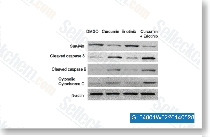
| S1848 | Curcumin | Curcumin (Diferuloylmethane, Natural Yellow 3, Turmeric yellow) is the principal curcuminoid of the popular Indian spice turmeric, which is a member of the ginger family (Zingiberaceae). It is an inhibitor of p300 histone acetylatransferase (IC50~25 μM) and Histone deacetylase (HDAC); activates Nrf2 pathway and suppresses the activation of NF-κB. Curcumin induces mitophagy, autophagy, apoptosis, and cell cycle arrest with antitumor activity. Curcumin reduces renal damage associated with rhabdomyolysis by decreasing ferroptosis-mediated cell death. Curcumin exhibits anti-infective properties against various human pathogens like the Influenza Virus, hepatitis C virus, HIV and so on. |
|
|
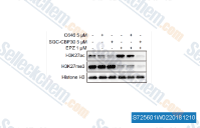
| S7256 | SGC-CBP30 | SGC-CBP30 is a potent CREBBP/EP300 inhibitor with IC50 of 21 nM and 38 nM in cell-free assays, respectively. Exhibits 40-fold and 250-fold selectivity for CBP over the first BRD of BRD4 (BRD4(1)) and BRD4(2) respectively. |
|
|
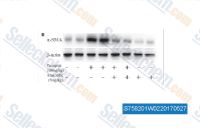
| S7582 | Anacardic Acid | Anacardic Acid (6-pentadecylsalicylic Acid) is a potent inhibitor of p300 and p300/CBP-associated factor histone acetyltranferases, which also has antibacterial activity, antimicrobial activity, prostaglandin synthase inhibition, and tyrosinase and lipoxygenase inhibition. |
|
|
| S9648 | NEO2734 (EP31670) | NEO2734 (EP31670) is a novel, orally active and selective dual inhibitor of p300/CBP and BET bromodomain with IC50 of both <30 nM. |
|
|
| S9432 | Ginkgolic Acid | Ginkgolic acid, toxic phenolic compounds present in the fruits and leaves of Ginkgo biloba L., is a potent sumoylation inhibitor also reported to inhibit Histone Acetyltransferase (HAT). |
|
|
| S8190 | CPI-637 | CPI-637 is a selective and cell-active benzodiazepinone CBP/EP300 bromodomain inhibitor with IC50 values of 0.03 μM and 0.051μM for CBP and EP300 respectively in TR-FRET assay. It is highly selective against other bromodomains, displaying substantial biochemical activity only against BRD9. |
|
|
| S1161 | Histone Acetyltransferase Inhibitor II |
Histone Acetyltransferase Inhibitor II (HAT Inhibitor II, compound 2c) is a potent, selective and cell-permeable p300 histone acetyltransferase (HAT) inhibitor with IC50 of 5 μM. Histone Acetyltransferase Inhibitor II shows anti-acetylase activity in mammalian cells. |
|
|
| S6876 | CPI-1612 | CPI-1612 is a highly potent, orally active inhibitor of EP300/CBP histone acetyltransferase (HAT). It displays an IC50 of 8.0 nM for EP300 HAT. CPI-1612 suppresses H3K27 acetylation in vivo and exhibits efficacy in JEKO-1 mantle cell lymphoma xenograft at a low dose. CPI-1612 displays anticancer activity. | ||
| S6886 | 1-Aminobenzotriazole | 1-Aminobenzotriazole (ABT, 3-Aminobenzotriazole, 1-Benzotriazolylamine, NSC 114498, NSC 656987) is a nonselective and irreversible inhibitor of cytochrome P450 (CYP) enzymes. This compound is also a substrate and inhibitor of N-acetyltransferase (NAT). | ||
| S9445 | Ginkgolic Acid (C13:0) | Ginkgolic Acid (C13:0), a natural anticariogenic agent in Ginkgo biloba L., exhibits antimicrobial activity against S. mutans and suppresses the specific virulence factors associated with its cariogenicity. This compound is a potent sumoylation inhibitor and reported to inhibit Histone Acetyltransferase (HAT). |

Products are for research use only. Not for human use. We do not sell to patients.
©Copyright 2013 Selleck Chemicals. All Rights Reserved.