
Technical Data
| Formula | C20H15ClF3N5 |
||||||||||
| Molecular Weight | 417.81 | CAS No. | 1029044-16-3 | ||||||||
| Solubility (25°C)* | In vitro | DMSO | 84 mg/mL (201.04 mM) | ||||||||
| Water | Insoluble | ||||||||||
| Ethanol | Insoluble | ||||||||||
| In Vivo (Add solvents to the product individually and in order.) |
|
||||||||||
|
* <1 mg/ml means slightly soluble or insoluble. * Please note that Selleck tests the solubility of all compounds in-house, and the actual solubility may differ slightly from published values. This is normal and is due to slight batch-to-batch variations. * Room temperature shipping (Stability testing shows this product can be shipped without any cooling measures.) |
|||||||||||
Preparing Stock Solutions
Biological Activity
| Description | Pexidartinib (PLX3397) is an oral, potent multi-targeted receptor tyrosine kinase inhibitor of CSF-1R, Kit (c-Kit), and FLT3 with IC50 of 20 nM, 10 nM and 160 nM, respectively. This compound induces apoptosis and necrosis with antitumor activity. Phase 3. | ||||||
|---|---|---|---|---|---|---|---|
| Targets |
|
||||||
| In vitro | In M-NFS-60, Bac1.2F5 and M-07e cells, Pexidartinib (PLX3397) inhibits the CSF1-dependent proliferation with IC50 of 0.44 μM, 0.22 μM and 0.1 μM, respectively. |
||||||
| In Vivo | In MMTV-PyMT mice, Pexidartinib (PLX3397) (40 mg/kg, p.o.) significantly inhibits both steady-state and PTX-induced tumour infiltration by CD45+CD11b+Ly6C−Ly6G−F4/80+. This compound/PTX therapy also results in a significant reduction in CD31+ vessel density within mammary tumours, paralleling induction of apoptosis and necrosis. In C57 mice bearing GL261 tumours, this compound (p.o.) inhibits glioblastoma invasion. In cmo mice, this chemical significantly attenuates autoinflammatory disease by decreasing the erosive bone lesions in tails and paws and the levels of circulating MIP-1α. In mice bearing B16F10 melanomas, this compound (45 mg/kg, p.o.) enhances CD8-mediated immunotherapy of melanoma. |
Protocol (from reference)
| Kinase Assay: |
|
|---|---|
| Animal Study: |
|
References
|
Customer Product Validation
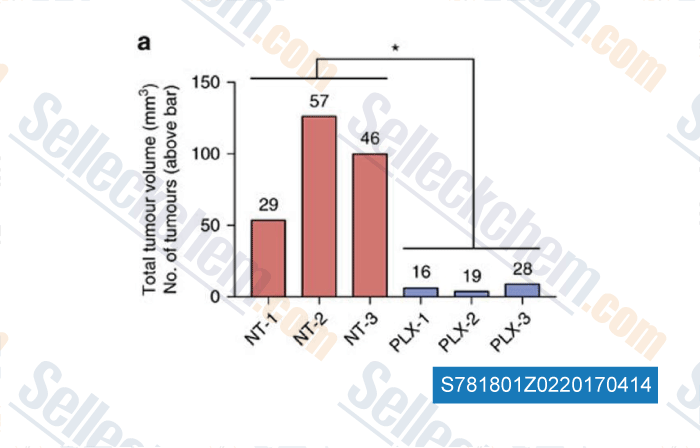
-
Data from [ , , Nat Commun, 2017, 8:14293 ]
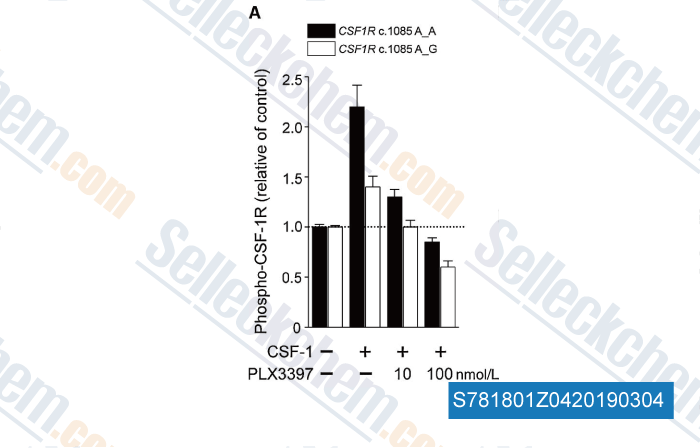
-
Data from [ , , Clin Cancer Res, 2017, 23(20):6021-6030 ]
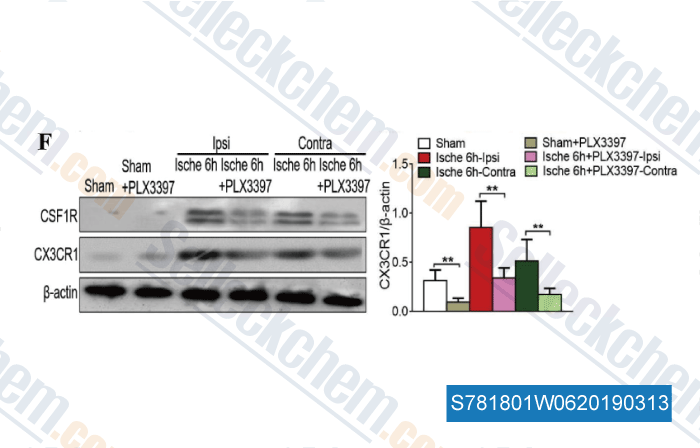
-
Data from [ , , Brain Behav Immun, 2018, 68:248-260 ]
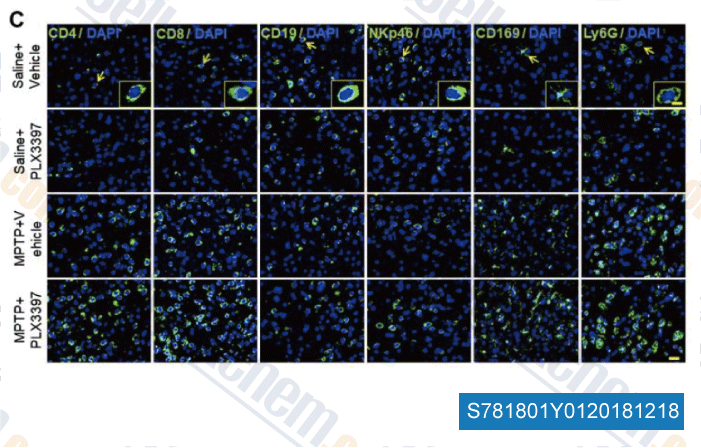
-
Data from [ , , FASEB J, 2018, 32(6):3336-3345 ]
Sellecks Pexidartinib (PLX3397) Has Been Cited by 129 Publications
| Targeting C1q prevents microglia-mediated synaptic removal in neuropathic pain [ Nat Commun, 2025, 16(1):4590] | PubMed: 40382320 |
| Small intestinal γδ T17 cells promote SAE through STING/C1q-induced microglial synaptic pruning in male mice [ Nat Commun, 2025, 16(1):6779] | PubMed: 40702081 |
| Microglia replacement by peripheral delivery of CSF1R inhibitor-resistant hematopoietic cells [ Mol Ther, 2025, S1525-0016(25)00871-8] | PubMed: 41232525 |
| Stress induces behavioral disorders by promoting microglial phagocytosis via decreasing neuronal Dkk3 [ Mol Psychiatry, 2025, 30(12):5731-5748] | PubMed: 41136744 |
| Exosome-mediated microglia-astrocyte interactions drive neuroinflammation in Parkinson's disease with Peli1 as a potential therapeutic target [ Pharmacol Res, 2025, 219:107908] | PubMed: 40816423 |
| Deciphering the preeclampsia-specific immune microenvironment and the role of pro-inflammatory macrophages at the maternal-fetal interface [ Elife, 2025, 13RP100002] | PubMed: 40152904 |
| Depletion of HSP60 in Microglia Leads to Synaptic Dysfunction and Depression-Like Behaviors Through Enhanced Synaptic Pruning in Male Mice [ CNS Neurosci Ther, 2025, 31(4):e70394] | PubMed: 40237297 |
| C3/C3aR Bridges Spinal Astrocyte-Microglia Crosstalk and Accelerates Neuroinflammation in Morphine-Tolerant Rats [ CNS Neurosci Ther, 2025, 31(1):e70216] | PubMed: 39801259 |
| Macrophage polarization, inflammatory monocytes, and impaired MDSCs are associated with murine and human immune aplastic anemia [ J Leukoc Biol, 2025, 117(6)qiaf073] | PubMed: 40411822 |
| Mechanistic study of pexidartinib-induced toxicity in human hepatic cells [ Chem Biol Interact, 2025, 419:111641] | PubMed: 40617559 |
RETURN POLICY
Selleck Chemical’s Unconditional Return Policy ensures a smooth online shopping experience for our customers. If you are in any way unsatisfied with your purchase, you may return any item(s) within 7 days of receiving it. In the event of product quality issues, either protocol related or product related problems, you may return any item(s) within 365 days from the original purchase date. Please follow the instructions below when returning products.
SHIPPING AND STORAGE
Selleck products are transported at room temperature. If you receive the product at room temperature, please rest assured, the Selleck Quality Inspection Department has conducted experiments to verify that the normal temperature placement of one month will not affect the biological activity of powder products. After collecting, please store the product according to the requirements described in the datasheet. Most Selleck products are stable under the recommended conditions.
NOT FOR HUMAN, VETERINARY DIAGNOSTIC OR THERAPEUTIC USE.