
Technical Data
| Formula | C28H24FN3O5 |
||||||
| Molecular Weight | 501.51 | CAS No. | 849217-68-1 | ||||
| Solubility (25°C)* | In vitro | DMSO | 100 mg/mL (199.39 mM) | ||||
| Water | Insoluble | ||||||
| Ethanol | Insoluble | ||||||
| In Vivo (Add solvents to the product individually and in order.) |
|
||||||
|
* <1 mg/ml means slightly soluble or insoluble. * Please note that Selleck tests the solubility of all compounds in-house, and the actual solubility may differ slightly from published values. This is normal and is due to slight batch-to-batch variations. * Room temperature shipping (Stability testing shows this product can be shipped without any cooling measures.) |
|||||||
Preparing Stock Solutions
Biological Activity
| Description | A potent VEGFR2 inhibitor with IC50 of 0.035 nM, Cabozantinib (XL184) also inhibits c-Met, Ret, Kit, Flt-1/3/4, Tie2, and AXL with IC50 of 1.3 nM, 4 nM, 4.6 nM, 12 nM/11.3 nM/6 nM, 14.3 nM and 7 nM in cell-free assays, respectively. It induces PUMA-dependent apoptosis in colon cancer cells via AKT/GSK-3β/NF-κB signalling pathway. | ||||||
|---|---|---|---|---|---|---|---|
| Targets |
|
||||||
| In vitro | Cabozantinib (XL184) has weak inhibitory activity against RON and PDGFRβ with IC50 of 124 nM and 234 nM, respectively, and has low activity against FGFR1 with IC50 of 5.294 μM. At low concentration (0.1-0.5 μM), it is sufficient to induce marked inhibition of constitutive and inducible Met phosphorylation and its resultant downstream signalling in MPNST cells, and inhibit HGF-induced MPNST cell migration and invasion. This compound also induces marked inhibition of Met and VEGFR2 phosphorylation in cytokine-stimulated human umbilical vein endothelial cells (HUVECs). Although it has no significant effect on MPNST cell growth at 0.1 μM, XL184 at 5-10 μM significantly inhibits the MPNST cell growth. | ||||||
| In Vivo | Cabozantinib (XL184) treatment at 30 mg/kg in RIP-Tag2 mice with spontaneous pancreatic islet tumours disrupts 83% of the tumour vasculature, reduces pericytes and empty basement membrane sleeves, causes widespread intratumoural hypoxia and extensive tumour cell apoptosis, and slows regrowth of the tumour vasculature after drug withdrawal, more significantly compared with XL999 that blocks VEGFR but not c-Met, leading to only 43% reduction in vascularity, suggesting that concurrent inhibition of VEGFR and other functionally relevant receptor tyrosine kinases (RTK) amplifies angiogenesis inhibition. This compound also decreases invasiveness of primary tumours and reduces metastasis. At 30 mg/kg/day, it significantly abrogates human MPNST xenografts growth and metastasis in SCID mice. Administration of XL184 induces dose-dependent inhibition of tumour growth in breast, lung, and glioma tumour models, in association with decreased tumour and endothelial cell proliferation as well as increased apoptosis. A single oral dose is sufficient to induce sustained tumour growth inhibition in MDA-MB-231 tumour-bearing mice and C6 tumour-bearing rats at 100 mg/kg and 10 mg/kg, respectively. |
Protocol (from reference)
| Cell Assay: |
|
|---|---|
| Animal Study: |
|
References
|
Customer Product Validation
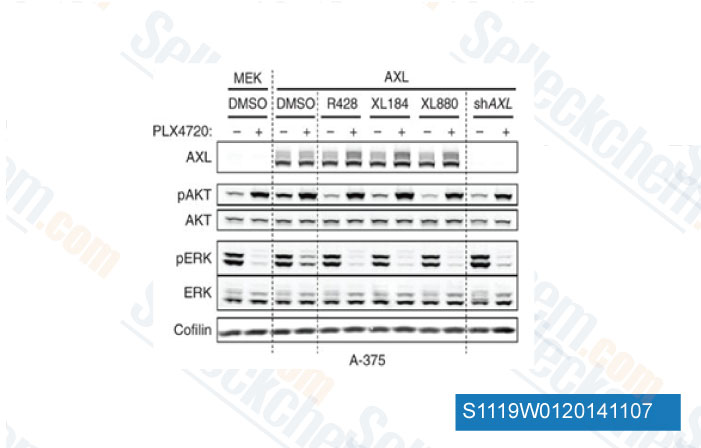
-
Data from [ Cancer Discov , 2014 , 4(7), 816-27 ]
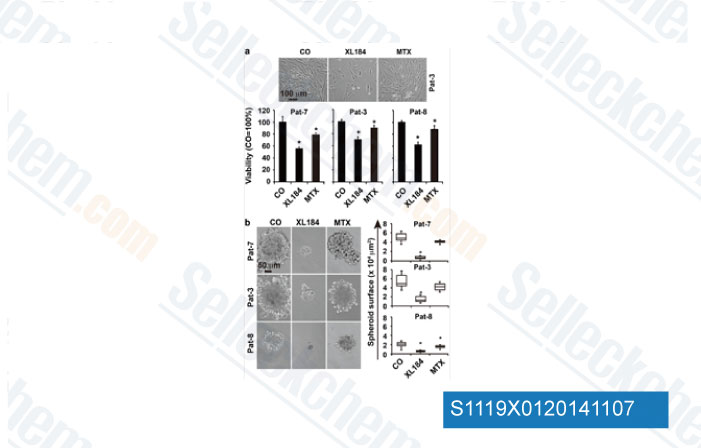
-
Data from [ Cell Death Dis , 2014 , 5, e1471 ]
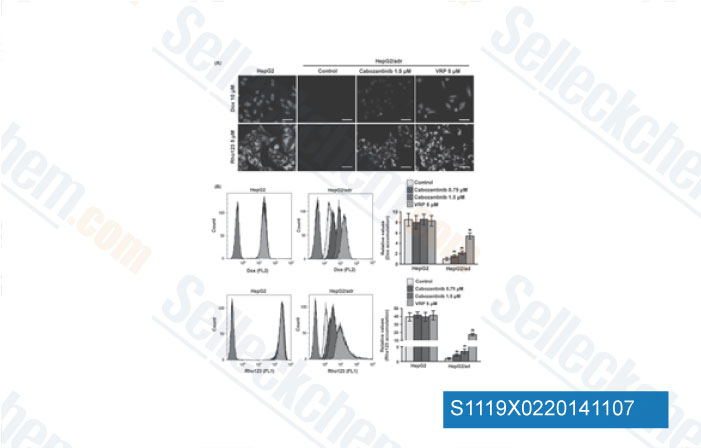
-
Data from [ Liver Int , 2014 , 10.1111/liv.12524 ]

-
, , Christina W Yde/CDM Danish Cancer Society Research Center Denmark
Sellecks Cabozantinib (XL184) Has Been Cited by 169 Publications
| S100P is a ferroptosis suppressor to facilitate hepatocellular carcinoma development by rewiring lipid metabolism [ Nat Commun, 2025, 16(1):509] | PubMed: 39779666 |
| ARID1A loss enhances sensitivity to c-MET inhibition by dual targeting of GPX4 and iron homeostasis, inducing ferroptosis [ Cell Death Differ, 2025, 10.1038/s41418-025-01510-x] | PubMed: 40369167 |
| Inhibition of TFF3 synergizes with c-MET inhibitors to decrease the CSC-like phenotype and metastatic burden in ER+HER2+ mammary carcinoma [ Cell Death Dis, 2025, 16(1):76] | PubMed: 39920140 |
| Relevance of transportome among the mechanisms of chemoresistance in hepatoblastoma [ Biochem Pharmacol, 2025, 237:116914] | PubMed: 40185314 |
| A Robust Marine Collagen Peptide-Agarose 3D Culture System for In Vitro Modeling of Hepatocellular Carcinoma and Anti-Cancer Therapeutic Development [ Mar Drugs, 2025, 23(10)386] | PubMed: 41149589 |
| Characterisation of an autochthonous mouse ccRCC model of immune checkpoint inhibitor therapy resistance [ Sci Rep, 2025, 15(1):19818] | PubMed: 40473819 |
| Sensitizing cholangiocarcinoma to chemotherapy by inhibition of the drug-export pump MRP3 [ Biomed Pharmacother, 2024, 180:117533] | PubMed: 39405909 |
| Construction of disulfidptosis-based immune response prediction model with artificial intelligence and validation of the pivotal grouping oncogene c-MET in regulating T cell exhaustion [ Front Immunol, 2024, 15:1258475] | PubMed: 38352883 |
| Novel therapeutic strategies targeting bypass pathways and mitochondrial dysfunction to combat resistance to RET inhibitors in NSCLC [ Biochim Biophys Acta Mol Basis Dis, 2024, 1870(6):167249] | PubMed: 38768929 |
| Patient-derived rhabdomyosarcoma cells recapitulate the genetic and transcriptomic landscapes of primary tumors [ iScience, 2024, 27(10):110862] | PubMed: 39319271 |
RETURN POLICY
Selleck Chemical’s Unconditional Return Policy ensures a smooth online shopping experience for our customers. If you are in any way unsatisfied with your purchase, you may return any item(s) within 7 days of receiving it. In the event of product quality issues, either protocol related or product related problems, you may return any item(s) within 365 days from the original purchase date. Please follow the instructions below when returning products.
SHIPPING AND STORAGE
Selleck products are transported at room temperature. If you receive the product at room temperature, please rest assured, the Selleck Quality Inspection Department has conducted experiments to verify that the normal temperature placement of one month will not affect the biological activity of powder products. After collecting, please store the product according to the requirements described in the datasheet. Most Selleck products are stable under the recommended conditions.
NOT FOR HUMAN, VETERINARY DIAGNOSTIC OR THERAPEUTIC USE.